
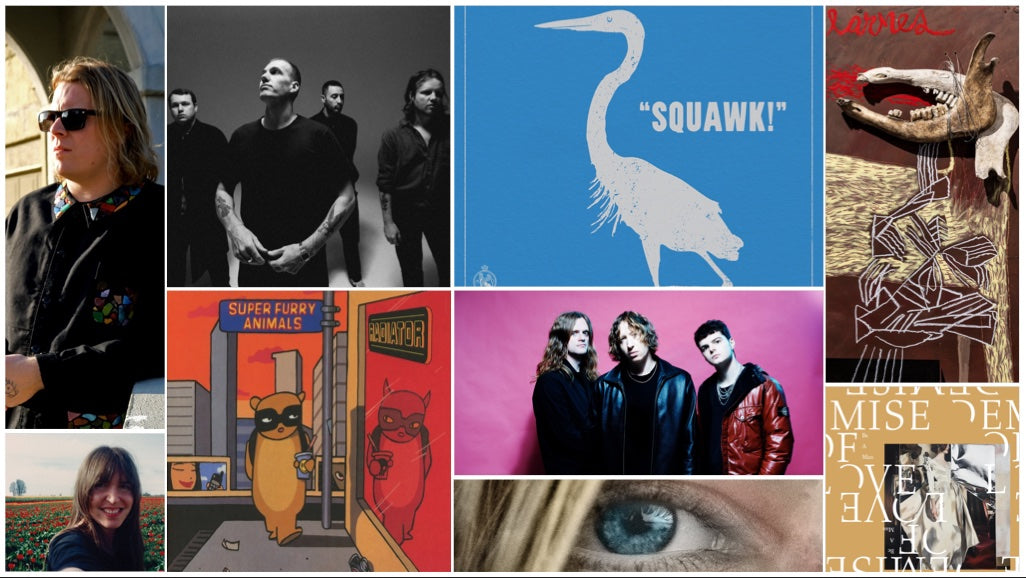
May has been a very solid month for albums and it goes out strong. I review seven: Ty Segall, Low‘s Alan Sparhawk with Trampled by Turtles, CIVIC, Sally Shapiro, SAVAK, The Minus 5, and ravey supergroup Demise of Love (aka Daniel Avery, Working Men’s Club and Ghost Culture). This week’s Indie Basement Classic looks back at Super Furry Animals‘ fantastic second album.
Over in Notable Releases, Andrew spins new ones from Garbage, The National’s Matt Berninger, Aesop Rock, and more.
Speaking of Ty Segall, I interviewed him about his great new album Possession and lots more.
Head below for this week’s reviews and see you in June when we get the first Pulp album in 24 years.
![[Album Art] Ty Segall - Possession](https://cdn.shopify.com/s/files/1/0521/6023/3669/files/Album-Art-Ty-Segall-Possession.jpg?v=1787887738)
Ty Segall – Possession (Drag City)
If you’ve ever felt intimidated by the sheer volume of Ty Segall’s releases, ‘Possession’ is not only a great album but a perfect place to start
Ty Segall puts out a lot of records. Some of them are heavy, some of them are soft, some of them are pretty out-there, and one of them was made entirely with percussion instruments. His 17th album under his own name, however, is something he’s never really done before. “This one was me trying to make a pop record,” he told us. Possession is Segall’s most immediate album yet—an ambitious swing for the fences where he mostly connects. It’s got big hooks and melodies, augmented by bravura string and brass arrangements from bandmate Mikal Cronin, and some of his most thoughtful lyrics to date (co-written with filmmaker Matt Yoka). And while there’s no shortage of guitars, most of the songs were written on piano. Or as Ty put it to us, “I threw the whole kitchen sink at this one, pretty much.”
Possession is steeped in the classics of the ’60s and ’70s, from late-’60s Beatles and The Kinks, to ZZ Top’s Tex-Mex boogie and The Allman Brothers Band’s soulful groove (the title track owes a little to “Midnight Rambler”). The electric piano used throughout the record gives everything a funkier edge that works especially well with the orchestral flourishes on “Buildings” and “Fantastic Tomb.” Where he’s gone for glorious guitar overload in the past, here he wields them for accent—dropping in a sweet lick between lines in a verse, or delicate acoustic arpeggios that float just under the surface. The strings and horns also give Possession a cinematic feel that underlines the emotions of the characters he and Yoka crafted in short story tales of petty larceny, urban sprawl, car culture, and exorcism. Add to that “Another California Song” and Possession plays out like a typical sunny day in Los Angeles—where weirdos still lurk just around the corner. No worries, though: Ty’s got the top down and this is playing on the AM radio.
—

Alan Sparhawk – With Trampled by Turtles (Sub Pop)
The Low co-founder and these bluegrass/folk vets makes for an inspired, only-in-Duluth combination
I can’t say that Minnesota bluegrass/folk group Trampled by Turtles have ever really been my thing—but maybe all you need to appreciate something is a new context. Backing Low’s Alan Sparhawk is an inspired, only-in-Duluth combination that has me wanting to check out their records. Sparhawk has known TBT since their days as a bar band in Duluth, when he and the late Mimi Parker served as early mentors for them. The band invited Alan to come in during some extra time they had at a recording session, which then turned into this album. Alan brought not only new songs but also a few from his archives that never quite worked for Low. The songs here are wonderful and a real showcase for Sparhawk’s soaring voice. If his vocoder-heavy 2024 solo album White Roses, My God was a little too out there (and not in a HEY WHAT kind of way), these nine songs really scratch that Low itch. Here, Trampled by Turtles are used more like a chamber ensemble—albeit one with a banjo—to put Sparhawk’s songs, which can still cut you to the bone, in a beautiful, moving new light.
—

CIVIC – Chrome Dipped (ATO)
The Melbourne band’s third album isn’t so much a radical reinvention but a glow-up: bigger, beefier, with just a little bombast
After two albums of gnarly, sun-bleached, Aussie-brand post-punk garage, Melbourne’s CIVIC looked to mix things up—to expand their parameters. “We kind of stuck to the rules a little bit earlier on, like do Australian punk rock properly and all that,” says guitarist Lewis Hodgson. “But after touring around the world and seeing what all these other bands are up to, it’s like, you can really do whatever the fuck you want. And so it’s fun to just kind of let go.” Chrome Dipped isn’t quite the dramatic shift that Fontaines D.C. went through on ROMANCE, but CIVIC have definitely welcomed melody and bigger production to the table. They also brought in Kirin J Callinan to produce, and his anarchic style opened the band’s eyes to new sonic directions. “He would deconstruct songs,” says Hodgson. “So what would initially be more of a punk rock song would turn into the Chrome Dipped that you hear. It really helped us, pulling the songs apart and putting them back together.”
The album title doubles as a good descriptor: just under that shiny coating is all the grit and gravel you remember. It’s not so much a left turn as a glow-up—bigger, beefier, with just a little bombast. Meanwhile, you can take the band out of Australia, but you can’t take Australia out of the band. The album opens with a slashing guitar riff that could’ve only come from Melbourne and powers “The Fool,” kicking things immediately into high gear. From there, we get side treks into pummeling rock (“The Hogg,” “Trick Pony,” “Fragrant Rice”), snarling shoegaze (“Amissus,” the Dinosaur Jr-y “Kingdom Come”), and then there’s “Starting All the Dogs Off,” which sounds a lot like Bambara—a Brooklyn band who sound Australian—so we’ve got the snake biting its own tail, human centipede style. The hooks are plentiful, the choruses memorable. All the while, McCulloch spits out phlegmatic lines like, “We’re all walking on frozen ground, all the way down.” CIVIC: 100% Australian, ready for the world.
—

Sally Shapiro – Ready To Live A Lie (Italians Do it Better)
More alluring, mysterious synthpop from this enigmatic Swedish duo
Wistful, mildly mysterious Swedish synthpop duo Sally Shapiro (Sally and Johan Agebjörn) reunited after nearly a decade for 2022’s Sad Cities, which added them to the Italians Do It Better roster—a label they fit like a neon-lit glove. Three years later, they’re back with its very enjoyable follow-up. On its own, Ready to Live a Lie is understated, but they’re playing at a higher tempo and with bigger beats than anyone else on their current label, aiming more directly for the dancefloor instead of the nearby chillout room. There are, of course, Italo disco bangers (Sally Shapiro’s bread and butter), but also forays into ’90s house, Japanese city pop, soft rock, delicate ballads, and a terrific cover of Pet Shop Boys’ “Rent.” Agebjörn, who wrote and produced nearly all the songs here, favors synth everything—the drums and keyboard parts, natch, but also things like “saxophones” and “guitars”—which adds an air of artifice that perfectly complements a title like Ready to Live a Lie. Then there’s Shapiro’s voice, as enigmatic as ever, making you wonder: is it all a dream?
—

The Minus 5 – Oar On, Penelope! (Yep Roc)
Featuring appearances by members of REM, The Bangles, Drive-By Truckers and more, the 16th Minus 5 album is another treat from musician’s musician Scott McCaughey
Scott McCaughey is a national treasure who really should get more credit and attention than he does, though he’s managed to eke out a nice life as a musician’s musician. Having gotten his start in the sardonic college rock band Young Fresh Fellows, Scott got to travel the world in relative anonymity when he joined R.E.M. in 1994 as a touring guitarist—a gig he held until the band called it quits in 2011. He juggles a handful of other groups with overlapping bandmates (including Steve Wynn and Peter Buck): The Baseball Project, Filthy Friends, and what’s now his longest-running project, The Minus 5. It began as a solo outlet in 1993 where Scott could explore more serious, less pop-culture-obsessed songwriting, but it quickly became his main thing—and a real band.
Thirty-three years later, The Minus 5 is an amalgam of everything McCaughey’s ever done, as is their 16th album, which mixes power pop and ’60s psychedelia with jokes and bummed-out lyrical gut-punches in equal measure. Oar On, Penelope! was made with an ace lineup that includes Buck, longtime drummer Linda Pitmon, Kurt Bloch (YFF, Fastbacks), and Debbie Peterson (The Bangles), plus appearances from Drive-By Truckers’ Patterson Hood and talented nepo baby Spencer Tweedy. Ed Stasium—who’s worked on records by Ramones, Talking Heads, The Replacements, and more—mixed it into one of McCaughey’s most pleasing aural creations since the early-’90s heyday of Young Fresh Fellows. It’s not going to make Scott famous—he’s never been out to make a real big splash—but it’s another feather in the cap of one of the best, most underrated artists of the last 40 years.
—

SAVAK – SQUAWK! (Ernest Jennings Record Co)
One of Brooklyn’s best, underrated bands just keep getting better
It feels like only yesterday that Brooklyn band SAVAK were formed by indie rock lifers Sohrab Habibion (Obits, Edsel) and Michael Jaworski (The Cops), with a rotating lineup that has included members of Holy Fuck, Nation of Ulysses, New Radiant Storm King, Silent Majority, and more. Now celebrating their 10th anniversary (their first show was exactly a decade ago) and seventh album, SQUAWK!, SAVAK have become one of the best, most reliable bands in the city—doing it mainly for their own artistic interests, which could be why their records keep getting better. Jaworski brings the pop hooks, while Habibion leans more experimental; they write their own songs, but a decade in, their influence on each other has made for increasingly cohesive albums. Here, in quick succession, you get the Stonesy “No Man’s Island,” followed by the dark, toothsome “American Vernacular” that falls somewhere between Wire and Can, and then the nervy new wave of “Casual Cruelty.” The songs come equipped with an informed, considered, weary social agenda—shaking their heads at the headlines but always looking for a way forward.
—

Demise of Love – Demise of Love EP (Domino)
Daniel Avery, Working Men’s Club and Ghost Culture are just enough cooks in the kitchen on their ravey, techno-fuelled debut EP
Daniel Avery describes Demise of Love, his new collaboration with Working Men’s Club’s Sydney Minsky-Sargeant and Ghost Culture’s James Greenwood, as “three distinct sonic personalities coming together to create something new entirely—a search for a burning light that could only exist between the trio,” saying they went into the studio “armed only with a love for each other’s work.” Each of these three brings a distinctive style—Avery’s techno-shoegaze hybrids, WMC’s acid house nostalgia, and Ghost Culture’s classic song structures—but the pieces lock together nicely on their debut EP. You can almost feel what each member brought to the table, from the airy synths to the gurgling, rolling 303s, and melodic choruses. Adding to the bonafides: the EP was mixed by Alan Moulder (My Bloody Valentine, Nine Inch Nails), with cover art designed by the great Trevor Jackson. The whole record could’ve been titled IYKYK, but even if you don’t know, these four songs stand up on their own. Let’s hope they stick together for more.
—

INDIE BASEMENT CLASSIC: Super Furry Animals – Radiator (1997, Creation)
It’s hard to pick a best Super Furry Animals album but their sophomore effort was a major level-up
From 1995–2005, Radiohead were arguably the most consistently great, forward-thinking band on the planet—but Super Furry Animals were a close second, and they brought something Yorke, Greenwood & co. didn’t have a lot of: fun. Gruff Rhys and the rest of the band met at a rave, were proudly Welsh, and weren’t afraid to sing in their native tongue or try out any style, all while carrying a wide anarchic streak. They also had the tunes. Their debut album Fuzzy Logic cemented the SFA style right out of the gate, and they only got better, weirder, and more fun, all while regularly landing in the UK charts. (Apparently, they hold the record for the most singles in the UK Top 40 that never managed to crack the Top 20.)
While it’s hard to pick a favorite album, the Furries majorly leveled up with Radiator—a record that’s leaps and bounds better than their debut. This is where they went from being gleeful pranksters (they put Welsh drug smuggler Howard Marks on the cover of Fuzzy Logic) to one of the most consistently great, wildly creative bands of the era. (They still are, even though they haven’t released new music in nine years.) Radiator incorporates Madchester-y shuffle (“Play It Cool,” “The Placid Casual”), Bowie-style space rock (“Demons,” “Bass Tuned to D.E.A.D.”), punk, and mutant pop (“Herman Loves Pauline”) into a sound that became distinctly their own. It’s also the first album to feature artwork by graphic designer Pete Fowler, whose style would become as synonymous with the band as their music. Radiator truly is a classic.
—
Looking for more? Browse the Indie Basement archives.
And check out what’s new in our shop.