
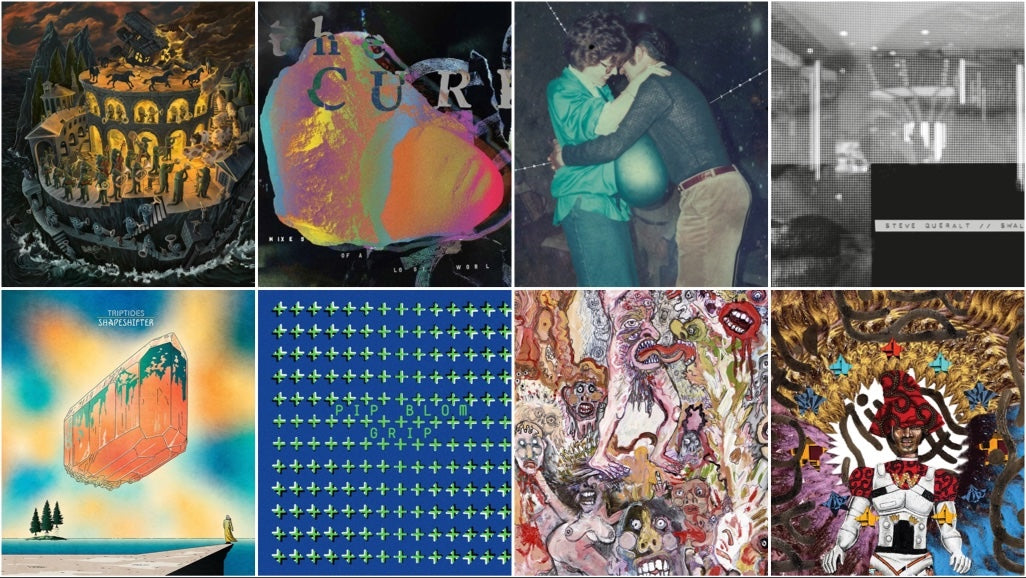
Happy June and happy lucky Friday the 13th! This week I review seven records, including The Cure‘s third remix album (featuring Four Tet, Daniel Avery, Mogwai, and 22 more) and the latest from your new favorite band The Bug Club, plus new ones from Zamrock greats W.I.T.C.H., King Gizzard & The Lizard Wizard (with an orchestra), Ride bassist Steve Queralt, and Triptides. The latter also inspired the choice of this week’s Indie Basement Classic.
Over in Notable Releases, Andrew spins the latest from Leikeli47, Neil Young & The Chrome Hearts, and more.
This has been a rough week, losing Sly Stone, Brian Wilson, Nitzer Ebb’s Douglas McCarthy, and our good friend Billy Jones over five days. 2025, please give us a little break.
Head below for this week’s reviews.

REMIX ALBUM OF THE WEEK: The Cure – Mixes Of A Lost World (Lost Music / Universal)
Do we need dance remixes of The Cure’s brilliantly depressing ‘Songs of a Lost World’? Turns out yes we do.
When listening to The Cure’s Songs of a Lost World, the band’s first album in 16 years, you might have thought, “Wow, this is great,” or “How does Robert Smith’s voice still sound this good at 65?”—but probably not, “I’d love to hear some dance remixes of these songs!” As Cure albums go, SOALW ranks up there with Disintegration and Pornography as one of their most mercilessly gloomy records—an album made for wallowing after midnight with black scarves draped over the lamps. And yet, here is Mixes of a Lost World that might make you want to get up and bounce around the room.
With a record as strong as Songs is, it’s clear the 24 remixers felt an obligation to bring their A-game, and the banger quotient on Mixes is impressively high. This is The Cure’s third remix album—1990’s Mixed Up and 2018’s Torn Down being the others—but it’s the only one focused on a single album, with each of the eight SOALW songs getting three different remixes. After opening with Paul Oakenfold’s “Cinematic” remix of “I Can Never Say Goodbye”—a perfect entrance—we step onto the dancefloor and don’t leave for 94 minutes. Four Tet’s skipping two-step take on “Alone,” Daniel Avery’s hazy, simmering, funky-drummer-fueled refurbishment of “Drone:Nodrone,” Orbital’s head-bobbing spin on “Endsong,” and Cosmodelica’s Balearic synthpop twist on “And Nothing is Forever” are standouts, keeping the inherent moodiness intact. There are no duds among these beat-forward remixes, though a couple do feel weirdly ecstatic given the tone and timbre of the originals.
The remaining eight remixes—including contributions from Deftones’ Chino Moreno, Mogwai, and Trentemøller—fall more into the heavy post-rock/ambient territory. They’re only available on the 3-LP / 3-CD deluxe editions (and streaming), and while they’re also good, you might find yourself asking: “Do any of these songs really need to be heavier, gloomier, and longer than they already are?” Clearly there are some who would raise a black-gloved hand to say yes, but this author would argue that, in that respect, The Cure have already achieved perfection.
Grab Mixes of a Lost World and other Cure vinyl in the BV shop.
—

NON-REMIX ALBUM OF THE WEEK: The Bug Club – Very Human Features (Sub Pop)
Shouty Welsh DIY indie duo tone down the shouting and up the charm on their wonderful fourth album. Your new favorite band? Very Human Features, the duo’s fourth album, Sam Willmett and Tilly Harris embrace melody, subtlety, and maturity—without losing any of their rough-hewn charm. The guitars jangle like The Vaselines or The Wedding Present, but everything’s turned up with levels deep in the red, including the vocals, which turns the otherwise sweet melodies into something more visceral and thrilling.
Willmett and Harris sound fantastic trading lines and harmonizing, and Very Human Features is loaded with earworms that might fuse with your DNA by the end of the first chorus. Just try not to shout along with “Jealous Boy,” “Beep Boop Computers,” “Full Grown Man,” and “Confidante.” There’s still plenty of (welcome) yelling and clever wordplay, including nods to film and TV—like on “Muck (Very Human Features)” when they sing, “It’s a funny shade of grey, blue or green or something you’ve seen on Doctor…Who the hell am I talking about?”
It’s like a roller derby involving the members of Belle & Sebastian: aggressive and twee but not, y’know, aggressively twee. It’s the kind of record that makes you wonder, “Am I listening to my new favorite band?” If you hadn’t already thought that about The Bug Club.
—

King Gizzard & The Wizard Lizard – Phantom Island ((p)doom)
These prolific Aussies go orchestral on their 27th album which is a string-and-horn-laden companion to last year’s ‘Flight b741’
When King Gizzard & The Lizard Wizard entered the studio to make what became 2024’s Flight b741, they ended up with too many songs. Of course they did—they’d already made 25 records since 2012. Ten tracks in particular, according to bandleader Stu Mackenzie, were “harder to finish. Musically, they needed a little more time and space and thought.” What they really needed, he realized, was orchestration—not in a classical sense, but more in a ’70s rock way, which these songs were already leaning toward.
Enter British conductor and arranger Chad Kelly, who shares the band’s love of odd tunings and microtonal instruments. The resulting album is more Love Unlimited Orchestra than Electric Light Orchestra—funky, and with just enough Southern-fried grease to keep things moving smoothly. It’s very much a twin to Flight b741, separated at birth, raised differently, but still with fun as first on the call sheet.
—

Steve Queralt – Swallow (Sonic Cathedral)
Ride’s bassist enlists members of Lush and Electrelane for his first solo album
As singers and guitarists, Andy Bell and Mark Gardner get most of the attention in Ride, but let’s not forget bassist Steve Queralt and drummer Loz Colbert—arguably the most awesome rhythm section of the original UK shoegaze scene. Steve Queralt takes a bit of the spotlight here with his first-ever solo album. Reluctantly, too. He’d been working on music off and on since Ride reunited, but had no plans to release any of it until Sonic Cathedral label head Nat Cramp heard it and convinced him to put it out into the world.
Part of the hesitation was that most of it consisted of ambient instrumentals—Steve had no desire to sing, and there’s even a track titled “I Do Not Sing”—but Cramp suggested calling in a few friends for vocal help, namely Emma Anderson (formerly of Lush) and Verity Susman (ex-Electrelane, now one half of MEMORIALS). “Swallow has turned out so much better than I had hoped, largely thanks to Emma and Verity’s contributions which sew the tracks together and shape it into an album,” says Steve. “I’d fallen out of love with it so many times I was thinking of calling it Loveless. But then, that wouldn’t be the whole story.”
The three vocal tracks—“Lonely Town” and “Swiss Air” featuring Anderson, and “Messengers” featuring Susman—are shimmering, noisy highlights and exactly what you’d hope for from those pairings. But the rest of Swallow is worthy too, drifting somewhere between Mogwai and Boards of Canada. Good stuff. OK Loz—your turn. Show us what you’ve got!
—

W.I.T.C.H. – SOGOLO (Partisan)
Second post-reformation album from these Zamrock pioneers is a joy
It’s been an interesting ride for W.I.T.C.H. (We Intend to Cause Havoc), who formed in the 1970s and created their own funky brand of garage rock they dubbed Zamrock. The band broke up in 1984 after a dozen years together when frontman Jagari Chanda found god and went to work in a gem mine. Their recordings would gain cult status and when filmmaker Gio Arlotta went to Africa to track Chandra down for a documentary, Chandra started playing again with W.I.T.C.H. keyboardist Patrick Mwondela as well as Dutch musicians Jacco Gardner and Nic Mauskovic who had joined the documentary crew on the trip. By the time the documentary was finished, W.I.T.C.H. 2.0 were touring and in 2023 they released their first album in nearly 40 years, Zango.
Gardner, who is a real sonic wunderkind, ended up being the architect for this new version of the band (he’s a full-time member now), getting great performances and all the sounds just right. Chanda and Mwondela remain the beating heart of the band. Their second album since returning is a real treat, joyous and danceable, and blooming more with every listen. “Gathering at Zango was not just a moment in time; it was a pivotal experience that fueled our creativity and ignited our passion to push boundaries,” says Mwondela. “This album is a reflection of that spirit—an exploration of new frontiers, where every note and lyric is a step into the unknown. We believe that music is a living, breathing entity that grows and changes, just as we do.”
—

Pip Blom – GRIP (self-released)
The Norwegian indie rock band put down guitars, pick up laptops and still manage to sound like themselves
When we last checked in with Norwegian indie band Pip Blom, they were dabbling in mid-’00s post-punk revival sounds—with help from one of that era’s architects, Franz Ferdinand’s Alex Kapranos. Now, after three albums on UK indie label Heavenly, they’ve all but dropped guitars and gone electronic on their first fully independent release. “I realized that there was a massive part of music I had never really listened to that I might actually really like,” says Pip. “I started thinking about the music we made and if there would be a way to combine both worlds. We slowly started to incorporate more dance elements into our songs. It started subtle with Bobbie, and now with this EP it has been a priority.”
Grip pulls early ’90s house and techno influences through some very 2025 filters (do you like Inner City?), while still somehow maintaining that distinct Pip Blom sound. “The main instruments are a little different,” Pip says, “but the sounds, melodies, and hooks are still very much us.” I hope they don’t give up guitars and real drums entirely—“Someday” is the most familiar-sounding track here—but Grip works.
—

Triptides – Shapeshifter (Label 51 Recordings)
The 10th Triptides album looks to Switzerland for inspiration but, don’t worry, there is no yodeling involved
Glenn Brigman has been making breezy psych-pop as Triptides since 2010. What began as mostly a solo project in Bloomington, IN has blossomed into a full band since his move to Los Angeles. Shapeshifter is the 10th Triptides album—not counting his excellent 2018 collaboration with Winter—and there’s a surprising, undeniable influence here that most listeners probably wouldn’t pick up on: Swiss duo Klaus Johann Grobe, specifically their 2014 album Im Sinne der Zeit.
The use of vintage organs on that record—the sounds and the playing style—draws a clear through-line to Shapeshifter. The staccato rhythms on “More Than a Friend” feel straight out of KJG’s “Les Greks,” while the dreamy tones on opener “Silent Life” seem directly lifted from “Schlaufen der Zukunft.” Glenn is clearly a fan, and when the songs kick in, it doesn’t feel like theft so much as arrangement inspiration.
His melodic sensibilities are much more pop—at times reminiscent of Real Estate—and there are some terrific, soaring psych tunes here, including “Silent Life,” “Connection,” and the wonderful “How Could It Be Too Late?” Imitation may be the sincerest form of flattery, but it can also be a jumping-off point for something genuinely worthwhile.
—

INDIE BASEMENT CLASSIC: Klaus Johann Grobe – Im Sinne der Zeit (Trouble in Mind, 2014)
With the Triptides album out this week, it seemed like a good time to induct this 2011 record into the Indie Basement Hall of Fame
Swiss duo Klaus Johann Grobe burst into my world with their second album, Im Sinne der Zeit, a pure groove machine built on the world’s greatest basslines, lithe, understated drumming, and funky old-school organs. It’s sung in German, sounds like it was recorded in a cave and I can say without a doubt that I have listened to this record more than any other that has come out since. There is something immensely satisfying in its minimalism and mystery: 11 years and a thousand plays later, I still have no idea what the songs are about, and don’t care, but the badass grooves on “Kothek,” “Between the Buttons,” “Aufstand,” “Les Greks” and “Wir Zwei” always make me want to dance. The groove is universal and this record rules.
Looking for more? Browse the Indie Basement archives.
And check out what’s new in our shop.