
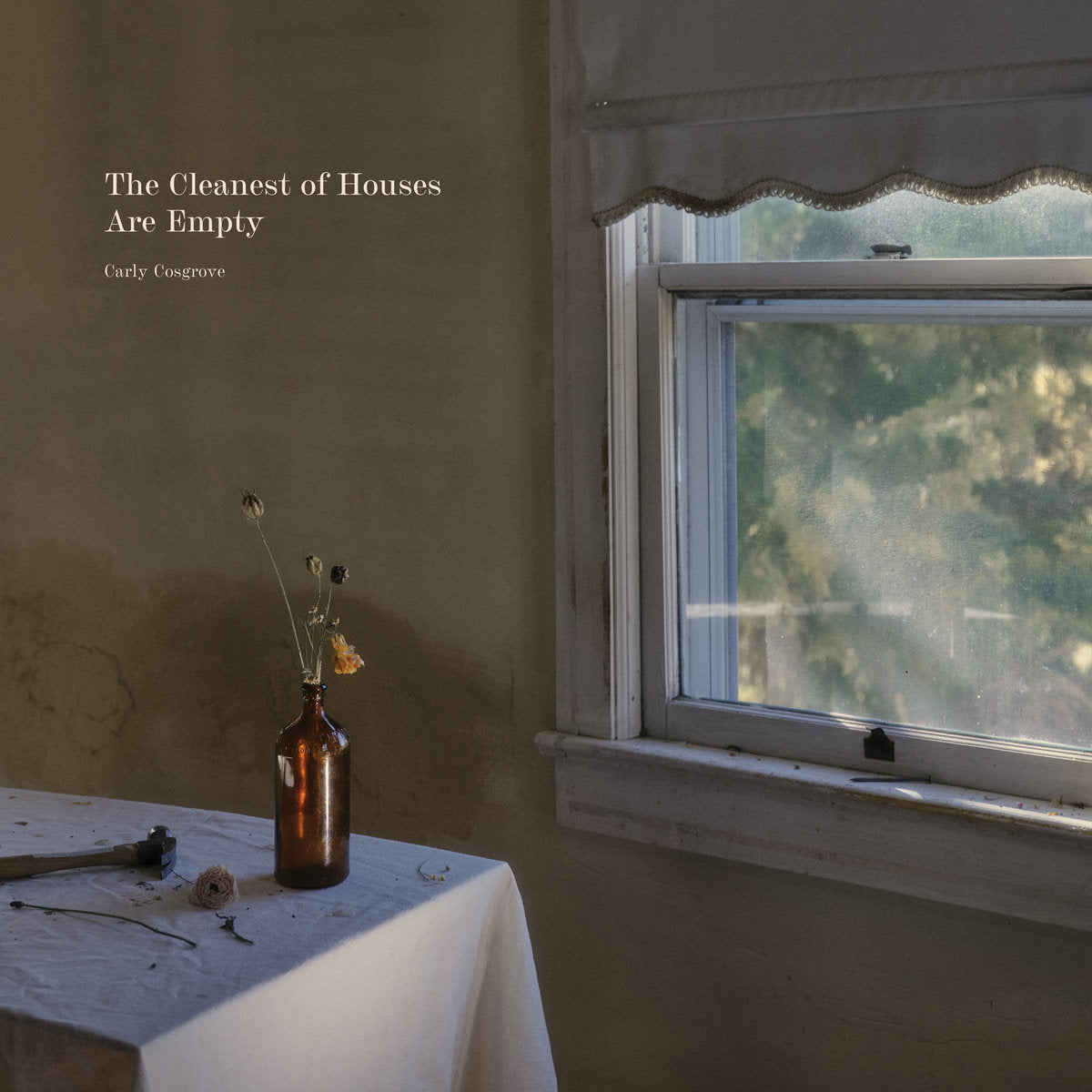
Philly emo band Carly Cosgrove may have kind of a goofy exterior (their band name, many of their song titles, and some of their visuals are, after all, references to Nickelodeon’s iCarly [and, in light of recent news, their mantra is now “Fuck Dan Schneider”]), but their sophomore album The Cleanest of Houses Are Empty couldn’t be more serious. Singer/guitarist Lucas Naylor wrote the album after going through a year-long depressive episode and being diagnosed with a personality disorder in the summer of 2022, and the resulting LP is essentially a highly personal concept album detailing that experience. It’s an album that’s emotionally devastating on multiple occasions, but also an album that’s upbeat, energetic, and very fun to listen to. Picking up where their 2022 debut LP See You In Chemistry left off, Carly Cosgrove deliver the kind of scrappy, melodic indie/emo/punk hybrid that bands like Modern Baseball, Joyce Manor, and Tigers Jaw helped shape in the previous decade, and they sound even louder and tighter on this LP. They made it at Studio 4 with Justin Bartlett (who Lucas knew from his time at Temple University and who’s since gone on to work alongside Will Yip), and drummer Tyler Kramer says says the idea was to make “a big, very live-sounding record” that harnesses the energy of their live show. If you ask me, that’s exactly what they’ve done.
For much more on the themes of this LP, Lucas walks us through the entire thing, track-by-track. Take it away, Lucas…
**
Track-by-Track Breakdown of Carly Cosgrove’s The Cleanest of Houses Are Empty
by Lucas Naylor
The Cleanest of Houses are Empty is a record about a year-long depressive episode. Over the course of the record, I try to explain what my particular bout of depression felt like. After a personality disorder diagnosis in the summer of 2022, it became hard for me to trust my own emotions. Out of fear that those emotions would create rifts in my intrapersonal relationships, I opted to isolate. The best way to avoid conflict was to avoid other people all together. And while conflict is a regular and healthy part of life, at the time, I couldn’t engage with it without completely shutting down. I ended up withdrawing from a lot more than I initially thought I had, and much more than I needed to. I hope that these songs explain my depression, wrought by lethargy and sloth, and the ways that it has manifested itself both internally and externally.
“Steered Straight” is sort of the impetus for the depression. It serves as a cautionary tale detailing the consequences of the “grass-is-greener” mindset. I had achieved a goal and had a life that I thought I wanted, only to realize that I had abandoned all of the things that were familiar to me and kept me grounded. I lost my foundation, and by extension, a lot of myself. The reality had set in that I was in new territory, and it was uncomfortable.
“You Old Dog” documents the epiphany that I have become unchanging. That the changes I thought I was making were just concessions to allow me to continue on with the same behaviors and reactions. At this point, I was so sunken into my depression that it was hard not to look back on every occasion where I had thought “this time is going to be different” and think that it was futile. I look back on all of the ambition I sacrificed in my depression, getting frustrated that I cannot come back to that passion with any semblance of ease, and overall, feeling trapped in my reality.
“We Don’t Want Your Cookies” takes the concepts from “You Old Dog” and expands on them. As soon as I realized I was a creature of the habits of my lethargy, it hit me that I was exhausted from them. It was a quick switch from the wide-eyed existential dread to being jaded with myself and grizzled. It is also the first song that expresses my desire for complete isolation.
“Here’s A Fork” is the first track where I really analyze my own emotions and how they influence the way I interact with others. I sort of identify the place where I am and the place I want to be, recognizing that my present means of interaction are not sustainable while still giving myself the grace to put words to those emotions while I have them. This was the first song that I finished lyrically for the record. It sort of became “the bar” to which all of the other lyrics on the record had to measure up to.
“Fluff My Pillow” is a love letter to my favorite vice amidst my depression: sleep. I was most comfortable unconscious because it was the most effective way to remove myself from the anxiety and discomfort I felt. It definitely became a crutch that I over-utilized. I thought it would be fun to detail the love of rest through a perverse power pop ballad, seeming triumphant and joyful on the surface while hiding the much more sinister results underneath. There’s even a cowbell part in this song. Who doesn’t love a fucking cowbell?
“Zoloft” elaborates on the conclusion that isolation was the only way forward. I talk about questioning my own reality, as well as feeling the barriers between myself and the people around me, even though I can present myself as seemingly unbothered to others.
“Random Dancing” applies these feelings to one of the instances where I did need to interact with the outside world. It documents the way in which depression inhibited my ability to advocate for myself, particularly within the music industry. Saying “yes” had become the path of least resistance, and fighting pyrrhic victories had become so exhausting that I allowed myself to get steamrolled. It got hard to know what was best for myself, and I think it became easy for people to take advantage of that if they wanted to. It didn’t help that I was in a place where I didn’t feel like I could trust my own reality and in a place where my depression made me both forgetful and unreliable.
“Stuck In My Straw” sort of introduces the next two songs by reminding me why I behaved the way I did in the face of my depression. It is the revelation that the point of my sabbatical was to rebuild. To come back to life with a new found trust in myself and a more objective outlook on what was going on around me.
“What Are You, A Cop?” is the first of two songs to attempt to challenge the way I have been dealing with my depression. I introduce a second, antagonizing character to attempt to sell me on some of the different distractions from those feelings that I could always have available to me as a means of not having to face those feelings head on. It is also sort of a study of the way that people who I looked up to have dealt with similar existential dread and why I wouldn’t choose to do the same.
I intended “The Impact of this Exit” to be a sort of internal battle with my past and present self. The antagonist from the previous song becomes more aggressive and more evil, seemingly under the guise of helping to pick me out of the depression, but ultimately kicking me while I’m down. I think that the conclusion I intended to reach with this song and with this album is this: I may not be in the best spot of my life, but I needed to get here to course correct from a reality that would have been a lot worse.
“North Star Bar” is an epilogue or a detour of sorts from the main narrative of the record, detailing a eulogy for a community that I only got to see from afar but never experienced up close. As an adolescent, I got to admire the music community I so badly wanted to be in from afar, only to watch it dissolve into something different by the time I was old enough to participate. I reflect on that feeling as I watch a much newer community than that one dissolve: one that I had participated in. In West Chester, Pennsylvania, there was a block of maybe two or three stores that cultivated community and threw punk shows, and that community brought me up. It was in those spaces where I played my first real shows. It was in those spaces where I learned how to participate and my community and where I met some of my best friends. All of those spaces are gone now. So in that respect, I suppose this song is a eulogy for that community too.
**
The Cleanest of Houses Are Empty is out now on Wax Bodega.