
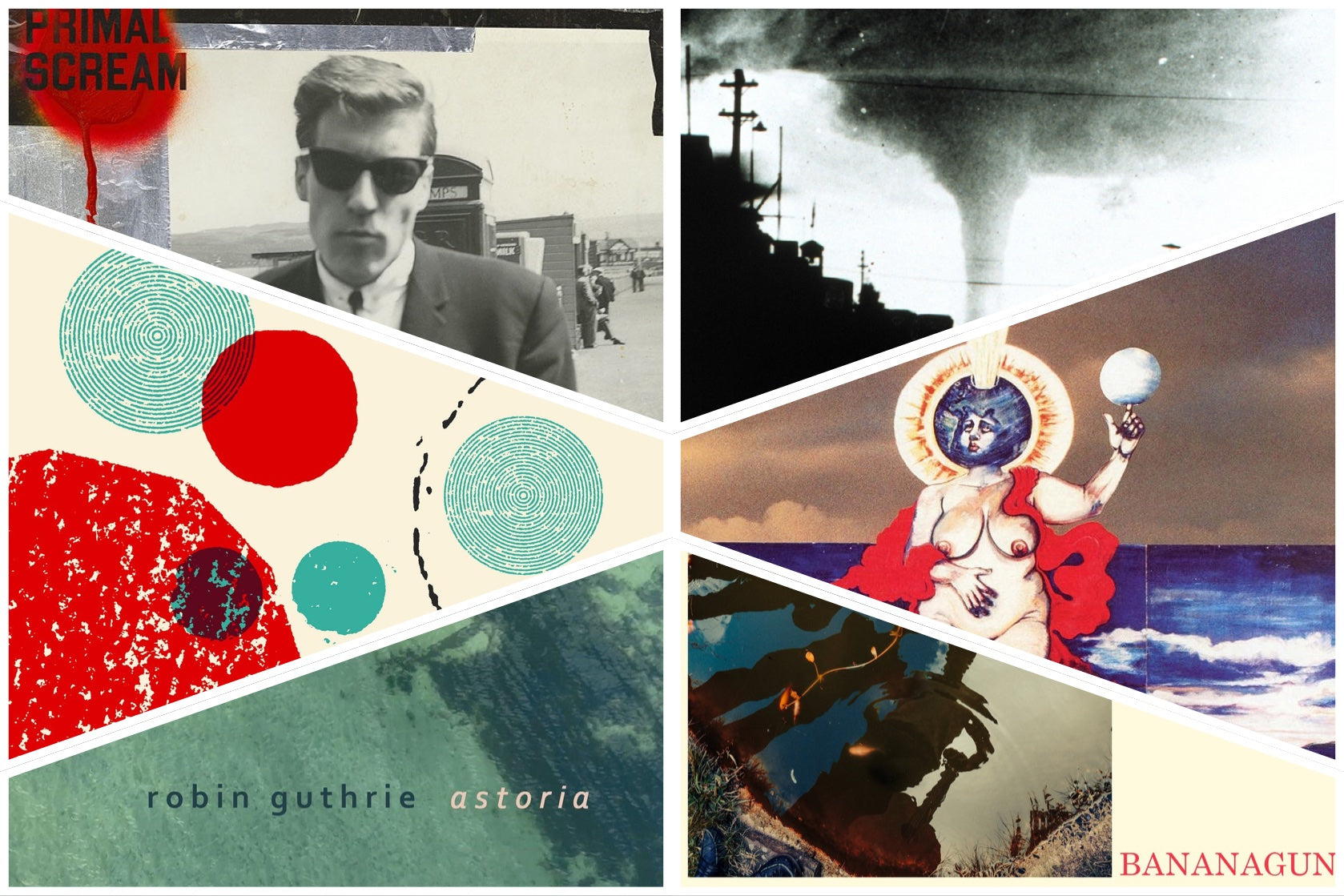
What to even say? Record labels and artists mostly cleared this week from their calendars which sadly turned out to be a smart move. Nobody wants their new album associated with this week. But there are a few releases, I review five and they’re all quite good: Primal Scream‘s first album in eight years (and fiercest political statement in 20) a new EP from Cocteau Twins‘ Robin Guthrie, a collab album between GLOK (Andy Bell of Ride) and DJ Timothy Clerkin, a heavy outing from Montreal neo-prog group Yoo Doo Right, and the second album from Aussie psych band Bananagun.
This week’s Indie Basement Classic is Julian Cope‘s double-album protest magnum opus from 1991.
Over in Notable Releases, Andrew reviews the latest from ferg, a Refused tribute (featuring IDLES, Touché Amoré, Fucked Up & more), Ab-Soul and more.
Head below for this week’s Indie Basement reviews…

Primal Scream – Come Ahead (BMG)
On their first album in eight years, Primal Scream are ready to fight all oppressors with string-laden disco. An unusual protest album, even for them. Great, too.
Bobby Gillespie was unsure if he ever wanted to make another album after 2016’s Chaosmosis. The album-tour-album cycle the band had been on for the last 20+ years was wearing him thin and it was not one of their best efforts. He took a break, wrote a terrific, entertaining memoir and made an album with Savages’ Jehnny Beth. Then COVID and the civil protests of 2020 happened, and keyboardist Martin Duffy died in 2022 from a fall. Throughout it all, however, Gillespie was writing songs again, saying his book unlocked something in him. That’s when producer David Holmes, who worked on Primal Scream’s 2000 album XTRMNTR and 2013’s More Light, sent him a backing track that Gillespie realized fit with some lyrics he’d written. He laid down vocals and sent it back to Holmes who replied, “Congratulations. The new Primal Scream album has just begun.”
Come Forward is Primal Scream’s 12th album and first in eight years. It’s easily their most focused, fiercely political album since XTRMNTR, yet they’ve never made an album that sounds quite like this before. While the ‘Scream have been fusing rock and dance music since landmark 1990 single “Loaded,” straight-up ’70s funk and disco, complete with swooping string sections, is new territory. Songs like “Ready to Go Home,” “Innocent Money” and “Love Insurrection” all approach Chic levels of suave sophistication while Gillespie sings of revolution against the ruling class, xenophobes, Brexitors, Trump, etc etc etc.
The title is a Glaswegian term that means if someone is looking to fight you, you say “Come ahead” which Gillespie notes means “Let’s fucking go!” He adds, “It’s redolent of the indomitable spirit of the Glaswegian, and the album itself shares that same aggressive attitude and confidence.” (Both Gillespie and Holmes are very pro-Palestine and if its not directly addressed in the lyrics, it’s felt.) As great sounding as the pure disco/funk tracks are, the ones that have a little grit and dirt on them feel more like Primal Scream: the fuzz bass on “Innocent Money,” the blown-out production on ragged rocker “Love Ain’t Enough,” dark-hued barroom ballad “Melancholy Man,” and the dubby portrait of alcoholism “Circus of Life” (which could be about Duffy, friend Shane MacGowan, both or neither). Then there’s “Dark Waters,” which meets racism, fascism and organized religion head-on while sounding like Joy Division by way of the Bee-Gees. It’s been a while since Gillespie, alongside the band’s not-so-secret-weapon, Andrew Innes, have sounded this engaged. Not all of it works, but most of it does and it’s inspiring that 40+ years into their career Primal Scream are still capable of something like Come Ahead.
—

GLOK/Timothy Clerkin – Alliance (Bytes)
Ride guitarist Andy Bell’s electronic alter ego makes his best record yet, a collab with Amsterdam-based DJ Timothy Clerkin
Andy Bell of Ride and Insult to Injury label head and DJ Timothy Clerkin first collaborated on a remix of “Projected Sounds” by Bell’s electronic alias GLOK back in 2019; they clicked immediately, creatively, but didn’t meet until they were both at Andrew Weatherall‘s funeral the next year. It’s a significant detail, as it’s clear the late DJ and Screamadelica producer’s work was inspiration on GLOK and Clerkin’s collaborative debut. It’s also clear that Bell and Clerkin bring out the best in each other. While it doesn’t quite have the sonic cohesion other GLOK records have, it makes up for it with more memorable songs and better beats that show off the full breadth of what they both can do.
“I handed control over to Tim for the production side,” Bell says. “My role was coming up with, and recording, musical ideas — and playing on his ideas. I’m not entirely sure who played what on what tracks, it all goes into the Clerkin blender and amazing music comes out!” Tim adds, I think people will probably think that I did the synths and Andy did the guitars, but we actually played a pretty equal amount of both! That’s one of the reasons I love it, it’s a proper collaboration, where we both tried new things and nothing was off limits.”
It’s the addition of guitars that makes Alliance so good, whether it’s the hazy chording on low-key banger “Nothing Ever” (featuring Du Blonde on vocals), the droning chug on “Scattered,” or the Bernard Sumner-esque New Orderisms of fantastic instrumental “E-Theme” that also tips its hat to Boards of Canada-style woozitronica. Speaking of New Order, tripped out acid house jam “Witching Hour” gets a lot of its power from a fuzzed-out bass lead that owes a lot to Peter Hook. This is easily the best GLOK record to date and maybe the the best non-Ride record made by a member of Ride ever. Even if not, this Alliance is more than the sum of its parts.
—

Yoo Doo Right – From The Heights Of Our Pastureland (Mothland)
This Montreal post-rock trio really nailed the release date of this dark, heavy record
I don’t aim to put too specific a time-stamp onto this column (even though in the headline it’s “the week in”), and am trying not to wallow in post-election gloom, but if there’s one record in today’s Indie Basement that really sounds like this week, it’s the new album from Montreal prog/komische/post-rock trio Yoo Doo Right. Just look at From the Heights of Our Pastureland ‘s album art with it’s bleak photo of a tornado looming against an urban backdrop. Those same grim vibes continue on the album’s 13-minute opener, “Spirit’s Heavy, But Not Overthrown.” (Even the title of the song sounds like now.) It begins with a mix of thick guitar noise and droning organ, sounding like the blackest clouds forming and then blotting out the sun as a violent storm arrives three minutes in, pelting you with nonstop diagonal rain, sleet and hail in the form of some seriously heavy sonic assault. (They clearly have taken a cue or two from their neighbors Godspeed You! Black Emperor.) It’s intense, so much so you might expect the album to end right there. But the onslaught continues with another 30 minutes of awesomely crushing music that at times is the musical equivalent of a garbage truck surfing a tidal wave of sludge, all put to tape with producer Seth Manchester (Battles, Lightning Bolt, Lingua Ignota). Things do lighten up, just a little, here and there, but you leave battered and bruised but not broken, and in its own way offering a cathartic beacon of hope in dark times.
—

Bananagun – Why Is The Colour Of The Sky? (Full Time Hobby / Anti-Fade)
Second album from this Aussie psych band is the whole fruit basket
Regular readers of this column may ask, on a weekly basis even, how much groovy tropicalia-spiked psych does one person need? Well at least a little more, in the case of Aussie band Bananagun. The Melbourne band released their terrific debut album in June 2020 and it’s one of many records that seem to have been lost to the pandemic, but hopefully that won’t happen to this one. If you’re a fan of all things 1967, there’s lots to love on Why Is the Colour of the Sky?, which takes elements of many varieties of vivid psychedelic rock and reduces it into one cup of mushoom tea. Let’s start with the three-man rhythm section (bassist Josh Dans, drummer Jimi Gregg, percussionist Charlotte Tobin) which is lythe and loose, ready for any tempo change or time signature shift thrown at them. Then there are singer-guitarists Jack Crook and Nick Van Bakel, the latter of whom also plays flute and trumpet. Add in sax players Pierce Morton and Miles Bedford, plus backup vocalist Joy Fox, and Bananagun are the whole rainbow, a deluxe fruit basket stuffed with catchy hooks and melodies and grooves that will keep you bobbing. The album’s also short, highly replayable and if you dig it, no better time to rescue their debut, The True Story of Bananagun, out of the covid chasm and hope for a tour because you can just tell this band are good live.
—

Robin Guthrie – Astoria (Soleil Apres Minuit)
More blissed-out gorgeousness from the Cocteau Twins’ chief sonic architect
Former Cocteau Twins guitarist is back with his second solo EP of the year. “My EP Astoria picks up where my release Atlas had set off towards – a conclusion of a journey, like an arrival at a far-off destination,” Robin says. “I enjoy the continuity, and the EP format allows me to express these ideas in an episodic form,” Like on Atlas, Guthrie has refined his style so much that discerning what instruments you’re hearing is more difficult than ever before. It’s a watercolor approach to sound, with heavily treated guitars that wash over you like synthesizers — or maybe they are synths? — and delicate piano (which could also be guitar?) slowly descends down a pastel-colored spiral staircase. Three of the four tracks feature drums that I will admit make me long for a voice — any voice, doesn’t have to be Liz — to enter the scene, but it’s the pure misty atmosphere of “Jura” that is Astoria‘s most transportive moment. Whatever he’s playing, it’s as gorgeous and ethereal as ever. Let the mystery be.
—

INDIE BASEMENT CLASSIC: Julian Cope – Peggy Suicide (Island Records, 1991)
The sprawling, high-concept double protest album masterpiece from one of my personal musical heroes
With as much acid and other chemicals as Julian Cope consumed during the ’80s, it’s a miracle the former Teardrop Explodes frontman could hold a spoon by 1991 let alone make the best album of his career. But that’s what he did on this psych-rock opus, a double album treatise on humankind’s disregard for its home, planet earth. This came after two separate attempts by major labels to turn him into a pop idol, and Cope had finally had enough, deciding to really let his hair down and fully let the freak flag fly (not that it was ever lower than half mast). He was still on Island Records, but he was now hanging out at Stonehenge, swimming with dolphins, and attending political protests as his 6’6″ alien alter ego, Sqwubbsy. Peggy Suicide is a sprawling and brilliant statement, making room for hallucinogenic trips (“Double Vegetation,” “Not Raving But Drowning’), epics about the AIDS crisis (“Safesurfer”), punk rock burners (“Hanging Out and Hung Up on the Line”), and indictments of Margaret Thatcher (“Leperskin”) and the state of police in the UK (the Lenny Bruce sampling “Soldier Blue”). It’s also got some of his best-ever pop songs in “Beautiful Love,” “Head” and “If You Love Me At All.” In letting it all hang out, Cope created a an album that is definitely weird, weirdly welcoming and the best place for the uninitiated to start.
—
Looking for more? Browse the Indie Basement archives.
And check out what’s new in our shop.
Creation Records’ 21 Best Records


