
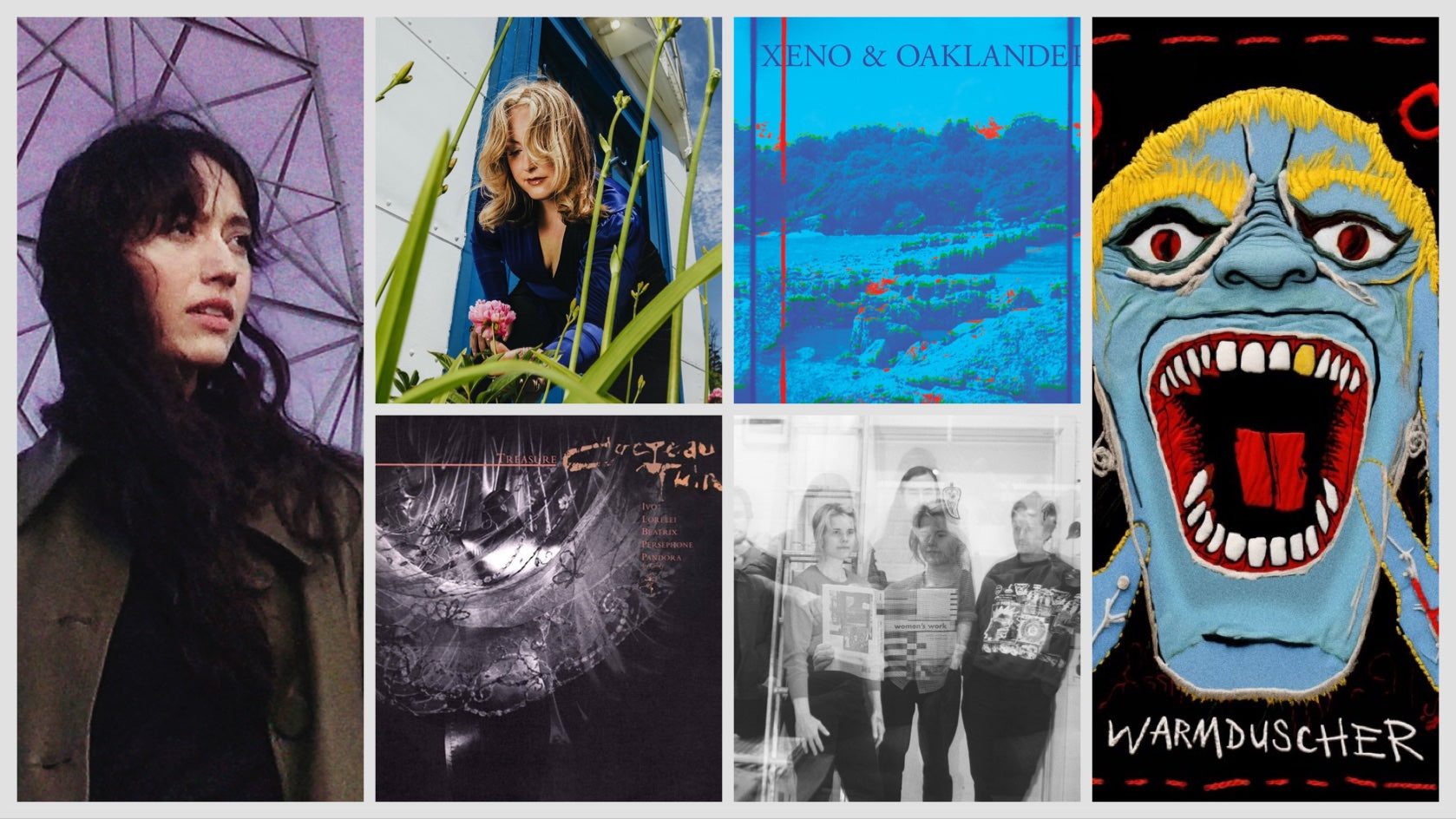
As we hit mid-November, the release schedule has started to slow down. I only review five new albums this week, but quality level is insanely high: I declared a three-way-tie for Album of the Week, and the other two aren’t far behind. We’ve got the latest from sleazy Londoners Warmduscher, The Green Child (Total Control’s Mikey Young and Grass Widow’s Raven Mahon who have turned their duo into a full band), the gossamer voice of Dorothea Paas, synthpop duo Xeno & Oaklander, and the long-awaited second album from New Zealand artist Fazerdaze.
For this week’s Indie Basement Classic, we’ve got Cocteau Twins‘ third album which is celebrating its 40th anniversary this week.
Over in Notable Releases, Andrew puts new albums from Pa Salieu, Maxo Kream, Full of Hell & Andrew Nolan, and more under the microscope.
It was a busy news week: Saint Etienne are going ambient on their 12th album; Portishead’s Beth Gibbons is coming to America this spring; The third and final G Stands for Go-Betweens box set is out in December; Ty Segall has a new band, Freckles; The Wedding Present will be touring with The Tubs in 2025; Jack White finally announces a proper tour; UK shoegazers bdrmm announced a new album; ’90s baggy scene band The Farm are back on the groovy train and making a new album;
Head below for this week’s reviews…

ALBUM OF THE WEEK #1: The Green Child – Look Familiar (Upset the Rhythm)
Raven Mahon (Grass Widow) and Mikey Young (Total Control / Eddy Current Suppression Ring) turn their synthpop duo into a full band for The Green Child’s excellent third album
The Green Child began as the musical extension of partners Raven Mahon (Grass Widow) and Mikey Young (Total Control / Eddy Current Suppression Ring), and their gentle, bucolic synthpop style was unlike any of their other respective groups. In the four years since their second album, Shimmering Bassett, they’ve turned The Green Child into a full band with the addition of drummer Shaun Gionis (of Boomgates) and keyboardist Alex Macfarlane. The difference is immediately apparent on Look Familiar, a decidedly more propulsive record than they’ve made before. A lot of it has to do with Gionis’ syncopated drumming style which is heavy on the toms, but really it’s the whole band vibe, with Raven on vocals and bass, and Mikey and Alex on both keyboards and guitar. The synths are still very, very spacey (proggy even) but layering them with guitars — and on “Easy Window,” real strings — it’s a much more magical sound and feels custom-built for Raven’s spectral voice. The songs are great and the band even lets it rip a couple times. Motorik standout “Year of the Books” shoots off some wild guitar/synth leads that would’ve been right at home on Brian Eno’s first two albums, and “Feet Are Rebels” shows they’re good at nervy, new wave-y rock too. With such a long break since the last album, I never thought we’d get another record, let along their best yet. The Green Child are dead, long live The Green Child!
—

ALBUM OF THE WEEK #2: Warmduscher – Too Cold to Hold (Strap Originals)
Sleazy Londoners are still living in the gutter but they’ve spruced the place up for their fifth album, and welcome guests like Irvine Welsh, Confidence Man’s Janet Planet and more to the party
You could call London’s Warmduscher “indie sleaze” if it wasn’t a term coined during the pandemic to describe mid-’00s rock debauchery. It’s just as well. Along with Fat White Family, these guys have been treating the gutter as their own personal playground, cutting post-punk with greasy funk and twangy rock and attracting the cognesenti of music’s underbelly (not to mention finding fans in Soulwax and Sleaford Mods). For Too Cold to Hold, though, they’ve tidied the place up a bit for what is their most sophisticated album yet. It’s still a place of elicit activity — the album opens with Trainspotting author Irvine Welsh detailing a DMT trip (“I slowly felt my body dissolve into digital dots, like The Matrix”) with ominous music rising underneath as his distinct brogue warps and shatters, leading into opening song “Fashion Week.” It’s there we get a taste of Warmduscher’s renovations. Luxurious xylophone bounces alongside a guitar riff and beat that would be at home on a Gang of Four record, as frontman Clams Baker paints a vulgar picture of the stylish and upwardly mobile.
“Pure at the Heart” featuring Confidence Man’s Janet Planet is next and is soulful in a Michael McDonald kind of way, and is the album’s juiciest jam. As the night continues and spills out on to the street, Baker is our tour guide, highlighting points of interest no one else would. He’s usually in talky vocal mode but on “Pure at the Heart” and in other places, he proves himself to be an appealing crooner (and should do it more). There are other guests at this party: Lianne La Havas shows up for “Body Shock,” a tale of workers in the wee hours and other night owls, and Coucou Chloe shows up on the jungle-powered “Cleopatras.” Classing up the joint works well for Warmduscher — the band’s Ben Romans Hopcraft co-produced with Jamie Neville — but you can still feel the rot under the new coat of paint. It helps that these are an especially hooky bunch of songs but the band are in top form, conning their way into a club where they don’t belong and making the most of it.
—

ALBUM OF THE WEEK #3: Dorothea Paas – Think of Mist (Telephone Explosion)
The US Girls and Jennifer Castle collaborator lets her amazing voice fly on her wonderful second solo album
What a voice! Dorothea Paas has been a mainstay on the Toronto scene since the early 2010s and if you don’t know her by name, you may have heard her sing on or contribute vocal arrangements to records by US Girls, Jennifer Castle, Badge Epoque Ensemble, Kiwi Jr, or Marker Starling. It’s on her own records, though, where her featherlight but powerful, acrobatic pipes take center stage and are capable of sending chills up your spine and stopping you in your tracks. Can a human sound like a flute? What about a one-woman version of the chorals in 10cc’s “I’m Not in Love”? Dorothea Paas can, and like on her 2021 debut, Think of Mist is a goddamn gorgeous record. Dorothea floats those harmonies atop jazzy melodies and arrangements, played by many of her past collaborators. She calls it “avant easy.” I call it “wow.” Do you find yourself anxious and stressed? This record is a soothing, healing balm, a much-needed epsom salt bath. “Are you ready to come into my world?” she sings on “Autumn Roses,” and the answer is yes.
—

Xeno & Oaklander – VIA NEGATIVA (in the doorway light) (Dais)
Twenty years into their existence, the synthpop duo of Sean McBride and Liz Wendelbo have made one of their most entertaining records
As Xeno & Oaklander, Sean McBride and Liz Wendelbo make synthpop the old-fashioned way, literally, as if technology never progressed past 1983 when step sequencers and drum machines were programmed note by note, and modular synths were linked via patch cables and manipulated with potentiometers and other knobs, sliders, and doohickies. They’ve been doing it this way for 20 years and are generally regarded to be part of the “minimal wave” sub genre, but their eighth album is anything but. Made in their “two-story synthesizer laboratory” at their Connecticut home, VIA NEGATIVA (in the doorway light) is a widescreen sci-fi epic full of high drama, dazzling special effects and lots of memorable songs. The album drops you into the deep end of their world with the opening cut — the title track — that swirls and swoops like a bravura, impossible-seeming single-shot take as McBride and Wendelbo trade lines. The vocal interplay is part of the key to this album’s enjoyability; Sean brings bellowing melodrama, while Liz is all icy cool, two very different systems communicating and working in perfect synchronization. But it’s also the maximalist arrangements that help give everything emotional heft, eye-popping style and such a high banger quotient. Despite using equipment that is either actually 40+ years old or designed like it was, VIA NEGATIVA sounds like a gleaming future.
—

Fazerdaze – Soft Power (section1)
Seven years after her debut, Amelia Murray finally makes a second Fazerdaze album. Worth the wait.
New Zealand musician Amelia Murray was 24 when she released Morningside, her debut album as Fazerdaze in 2017. The record garnered praise around the world which she toured. And then, nothing. “I really wasn’t expecting things to take off as well as they did,” she told Rolling Stone Australia last year. “I don’t know how someone like Billie Eilish or Lorde can cope with things.” She was burnt out from the acclaim and the pressure to follow up Morningside, but she was also in a bad relationship with someone 20 years her senior that took a while to wriggle free from. “This is what I created during the darkest, loneliest, most tumultuous years of my life,” Murray says of her second Fazerdaze album which she produced herself. She says she’s in a better place now and it sounds like it: Soft Power is a better record than Morningside, also bigger and more ambitious. The subject matter of songs like “A Thousand Years,” “Distorted Dreams” and the album’s title track may be heavy, but she wraps her words in melodies that grab you instantly, made with grander, dreamier arrangements and production. Her way with a chorus hasn’t diminished and her skill with layering sounds and hooks has grown, as you can hear on nearly every song on the album. It’s impressive, she’s made a very personal record both approachable and replayable.
—

INDIE BASEMENT CLASSIC: Cocteau Twins – Treasure (4AD, 1984)
Released 40 years ago this week, ‘Treasure’ is a truly gorgeous album that sounded like nothing else at the time and is where Cocteau Twins became the otherworldly band people still obsess over today
When Cocteau Twins released their 1982 debut album, Garlands, there were flashes of the ethereal band they would become, but at that point they were basically better-than-most Banshees clones with a talented guitarist and promising lead singer. They improved by leaps and bounds on 1983’s Head Over Heels, with Elizabeth Fraser flexing her vocal muscles and Robin Guthrie spinning delicate webs of guitar on “Sugar Hiccup.” But it was Treasure, their first album as a trio with multi instrumentalist Simon Raymonde, where Cocteau Twins became the otherworldly group fans obsess over still. Released November 12, 1984, Treasure is a truly gorgeous album that sounded like nothing else at the time, with Fraser’s multi-octave range spiraling skyward, intertwined with Guthrie’s celestial fretwork. Brian Eno was actually approached to produce but — according to 4AD’s Ivo Watts-Russell — he told the band, “I’m really flattered that you’ve asked, but I’d never have had the courage to use the size of reverb that you used on Head Over Heels!” and he suggested they do it themselves. Which they did with fantastic results. Though their sound had mutated, Cocteau Twins were also still very, very goth, from the mix of synthy chimes and swirling acoustics of “Ivo” to the ornate melodrama of “Beatrix,” the crashing, thunderous drum machines and jagged guitar and slithering bass of “Persephone” and “Cicely,” and the choral ice palace of “Donimo.” You also cannot discount the visual aspect of the Cocteaus, from Vaughn Oliver’s iconic Treasure artwork (which adorned the walls of many college student bedrooms in the ’80s), to their coifs that were as meticulously crafted as their music. Treasure is as much a world of lace and candles as Stevie Nicks was inhabiting at the time, just not one where Tom Petty might show up.
Looking for more? Browse the Indie Basement archives.
And check out what’s new in our shop.
Top 20 Shoegaze EPs of the Early-’90s


4. Moose – Jack (1991, Hut)


