
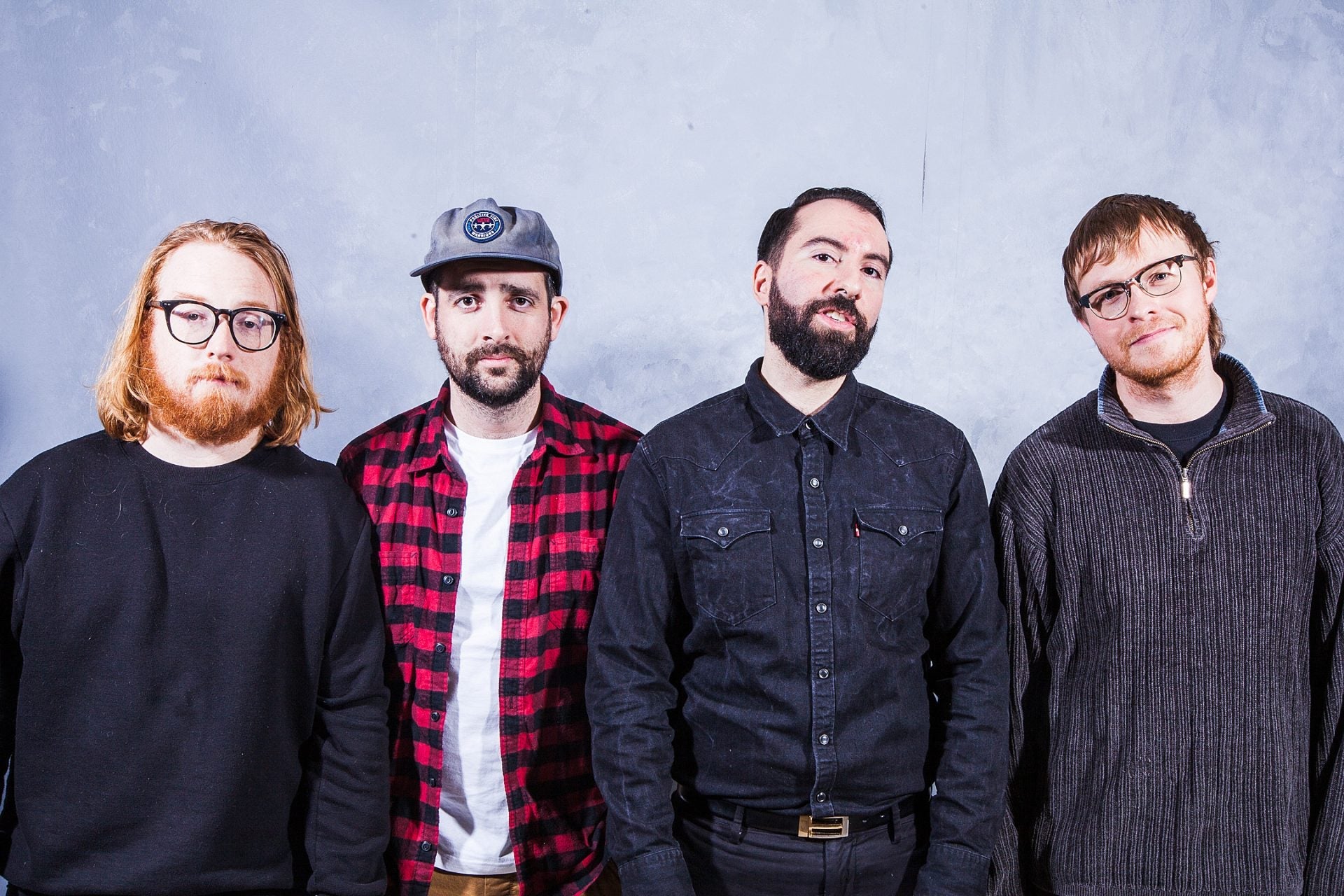

Toronto punks Pkew Pkew Pkew have announced a new album, Open Bar, due May 13 via Dine Alone (pre-order). It was produced by Jon Drew (Tokyo Police Club, Fucked Up, METZ) and made with “songwriting guidance-and-support” from The Hold Steady’s Craig Finn, and you can definitely hear some of The Hold Steady’s heartland rock coming through in the rip-roaring lead single “Maybe Someday.”
“This song is about sharing a bedroom with [guitarist] Ryan to save money on rent,” vocalist Mike Warne says. “It worked for a few months because we both stayed at our partners’ houses, but when Ryan’s fiance moved to Edmonton, suddenly he was home all the time.” Check out the video below.
About the album overall, Mike continues, “Since we didn’t have a hard deadline to finish, we felt a lot more freedom to take our time and mess around in the studio. Jon is the kind of producer that is down to try anything, so we had lots of fun playing with trumpets, old moog synths, glockenspiels.”
Pkew Pkew Pkew are also opening part of The Bouncing Souls‘ spring tour. All dates are listed below.

Tracklist
1. Let The Bridges We Burn Light The Way
2. Mom’s Dime
3. Maybe Someday
4. Mr. Meowers
5. Fresh Pope
6. Beer Stick ‘n’ Ched
7. Safety Last
8. A Different Jimmy
9. Stick To Your Guns, Pookie
10. Drinking In The Park
11. Young Pro
Pkew Pkew Pkew — 2022 Tour Dates
Apr 22 Fri Beat Kitchen Chicago, IL, United States *
Apr 23 Sat Beat Kitchen Chicago, IL, United States *
Apr 26 Tue Magic Stick Detroit, MI, United States *
Apr 27 Wed Rec Room Buffalo Corners, NY, United States *
Apr 28 Thu Spirit Hall Pittsburgh, PA, United States *
Apr 29 Fri Grog Shop Cleveland, OH, United States *
Apr 30 Sat Phantom Power Millersville, PA, United States *
* – w/ The Bouncing Souls
—
18 Essential Early 2000s Melodic Punk & Hardcore Albums

Kid Dynamite – Shorter, Faster, Louder (2000)

Alkaline Trio – Maybe I’ll Catch Fire (2000)

Rancid – Rancid (2000)

AFI – The Art of Drowning (2000)
Black Sails is usually the AFI album that's considered "the one that's cool to like," and Sing the Sorrow is usually the one that's considered the biggest musical and cultural achievement. Coming right in between them, The Art of Drowning is loved by longtime fans but might get overlooked by casual listeners or newcomers for not having much of a defining narrative beyond "the one after Black Sails" or "the one with 'The Days of the Phoenix.'" "Days of the Phoenix" is a milestone in AFI's career; it's the song that most predicted the sound of Sing the Sorrow, helped gain the band major label interest, and it's the one Nitro Records era song you're guaranteed to hear at an AFI show today. No matter how many times I hear that song, it never ceases to feel like the first time. It's a true classic, but it shouldn't overshadow the rest of The Art of Drowning, which is a much clearer progression from Black Sails than it sometimes gets credit for being.
"Days of the Phoenix" is also the one song on The Art of Drowning where AFI realize that if they settle into a mid-tempo alternative rock pace, they sound like they could be the biggest band in the world (and they'd do this for most of their career afterwards), but it's far from the only song on the album with masterful songwriting. Much more so than on Black Sails, Davey shows off his singing voice on The Art of Drowning, and the album’s got hooks for days -- not just from Davey but also from all the gang vocals and group whoa-ohs that are just about as perfect here as they would be on Sing the Sorrow. It'd probably be easier to list the songs that don't have cathartic choruses, but here are some of the ones that very much do: "Sacrifice Theory," "The Nephilim," "A Story At Three," "Catch A Hot One," "Wester." All of those are played at Misfits speed, but they come with blissful melodicism that proved AFI were just too good to remain in the punk underground for much longer. It's pop and punk without being "pop punk" -- it's still too dark and heavy for that -- and its combination of darkness, intensity, and remarkable melodies still feels innovative twenty years later. [Read more in our AFI album guide.]

The Movielife – This Time Next Year (2000)

Propagandhi – Today’s Empires, Tomorrow’s Ashes (2001)

Anti-Flag – Underground Network (2001)

The Bouncing Souls – How I Spent My Summer Vacation (2001)

Strike Anywhere – Change Is A Sound (2001)

The Lawrence Arms – Apathy and Exhaustion (2002)

Against Me! – Reinventing Axl Rose (2002)

Dillinger Four – Situationist Comedy (2002)

Hot Water Music – Caution (2002)

Rise Against – Revolutions Per Minute (2003)

The Distillers – Coral Fang (2003)

Bad Religion – The Empire Strikes First (2004)
Bad Religion never really went anywhere so don't call it a comeback, but after two less-well-received major label albums without original guitarist/songwriter Brett Gurewitz, Brett rejoined the band in 2001, the band re-signed to his label Epitaph Records, they welcomed the insanely hard-hitting new drummer Brooks Wackerman (previously of Suicidal Tendencies, currently of Avenged Sevenfold, among many other projects), and they released the excellent 2002 album The Process of Belief. It rivals their classic late '80s/early '90s run and it's home to songs that are still live staples and fan favorites today. It can't be easy to follow up a big comeback like The Process of Belief, but Bad Religion did it by getting harder and faster than ever on The Empire Strikes First. With the metal chops of Brooks Wackerman behind the kit, Bad Religion could now write menacing songs like "Sinister Rouge," which seems to answer the question: "what if Slayer were a pop punk band?"
Pop punk as we know it wouldn't exist without Bad Religion, whose 1988 LP Suffer was one of the '80s punk albums that shaped the '90s pop punk boom, and when Green Day and The Offspring were bringing punk to the masses with 1994's Dookie and Smash, Bad Religion were right there with 'em with their popular 1994 major label debut Stranger than Fiction. But a decade later, mainstream pop punk was very bubblegummy and Bad Religion went in a more aggressive direction, all while retaining the melodies, harmonies, and whoah-ohs that made people fall in love with Suffer. Like The Process of Belief, The Empire Strikes First is home to some of the band's most classic songs, and that's no small feat for an album released by a punk band who were then 24 years into their career (now 40). Coming at the height of George W. Bush backlash and the Iraq War, The Empire Strikes First tackled the capitalist greed that accompanies war ("Let Them Eat War"), religious conservatives ("God's Love"), California wildfires ("Los Angeles Is Burning"), and other then- (and now-) relevant topics that made The Empire Strikes First rank among the most incisive Bush-era protest music. It sounds lyrically urgent and musically thrilling in the Trump era too, and here's to hoping one day it only sounds the latter.

Latterman – No Matter Where We Go..! (2005)
