
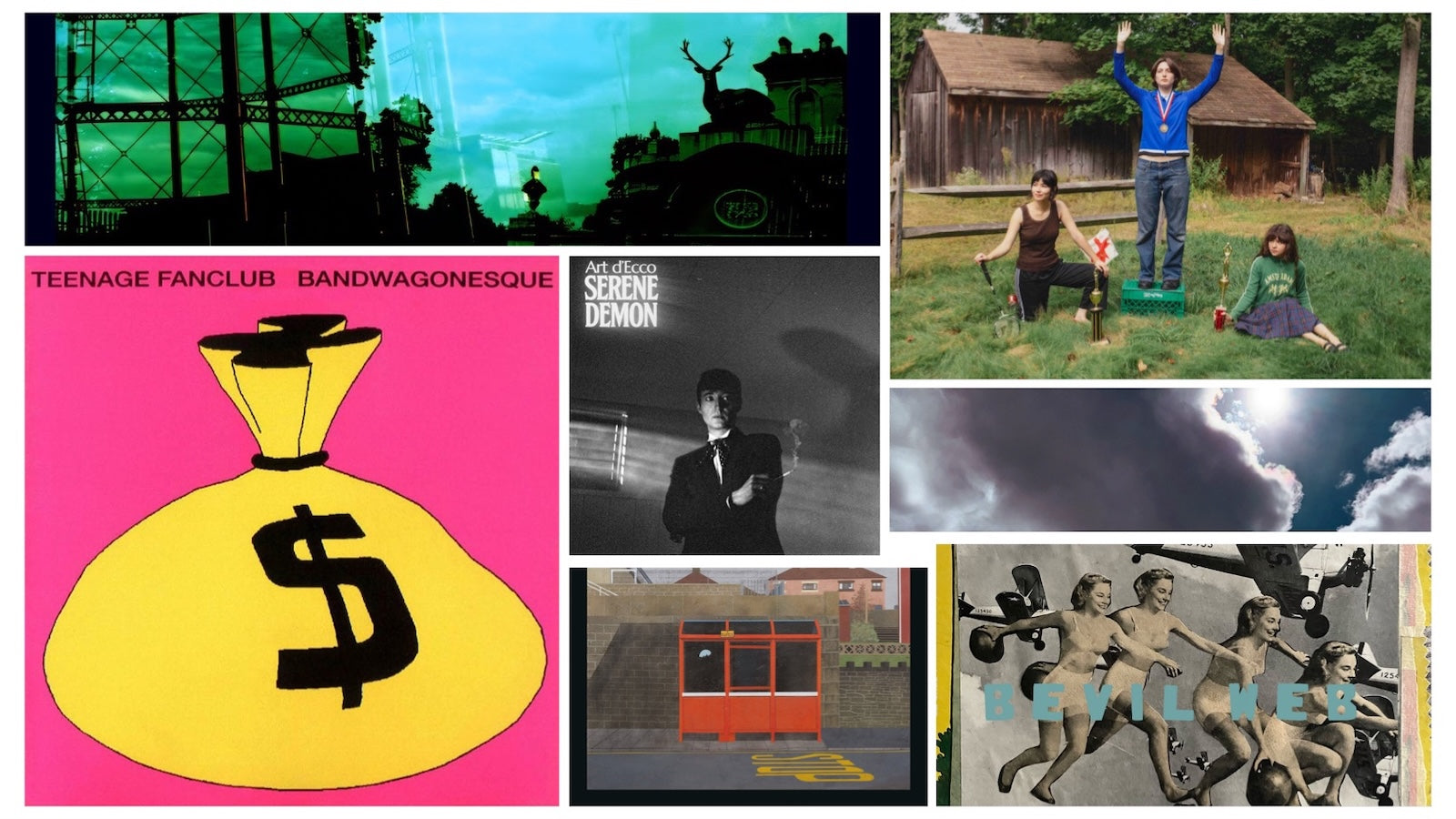
Valentine’s Day is a loaded day to release a record and is probably not many artists’ personal choice (except maybe Drake). I’m happy to report that none of the six albums out today that I’m reviewing are the sonic equivalent of a three course pre-fix meal that ends with a flourless chocolate cake. These are homemade creations crafted with love, but not the ooey gooey kind greeting cards peddle.
Where am I going with this? I don’t know but here’s what we’ve got this week: the excellent second album from Chicago trio Horsegirl; a pedal-steel-fueled collaboration between Wire offshoot Immersion and ambient country pioneers SUSS; a new EP from former Guided by Voices member Tobin Sprout; the ambitious fifth album from Vancouver’s glammy Art d’Ecco; UK prog-folk artist Richard Dawson explores domesticity on The End of The Middle; and Halifax band Kestrels continue to fly the shoegaze flag proudly.
This week’s Indie Basement Classic comes to us from Glasgow 1991. Any guesses?
Over in Notable Releases, Andrew reviews the latest from John Glacier, Venturing (Jane Remover), Cryogeyser, and Church Tongue.
Speaking of Horsegirl, I talked to them about working with Cate Le Bon on their new album, Skippy Vs Jif, Chicago Vs NYC and lots more.
Other news Basement readers might be interested in: John Dwyer of OSEES has made an album with original Adam & The Ants / Bow Wow drummer David Barbarossa under the name Chime School; Peter Murphy made a song with Trent Reznor; American Analog Set are playing their first NYC shows in 20 years (opening for Death Cab); Ministry will play their formerly disowned early-’80s material on tour this year; and UK synthpop vets Blancmange will tour the US for the first time in nearly 40 years.
That’s enough small talk. Head below for this week’s reviews…

ALBUM OF THE WEEK: Horsegirl – Phonetics On and On (Matador)
Cate Le Bon helps Horsegirl find their best selves for their excellent second album
One of the most promising bands of the early-’20s, Chicago trio Horsegirl released their first single, signed to Matador, and made their debut album at Steve Albini’s Electrical Audio with John Agnello while still in high school. That record, 2022’s Versions of Modern Performance, is dense and hazy in mostly the right ways — it’s terrific — but their second album is markedly better. A big part of that is Penelope Lowenstein, Nora Cheng and Gigi Reece becoming better, more confident songwriters and performers due to three years of touring and life in general, but another part is for Phonetics On and On they were paired with a kindred spirit in Welsh musician/producer Cate Le Bon. The trio, who currently live in NYC (Nora Cheng and Penelope Lowenstein are attending NYU), spent two weeks recording with Le Bon at Jeff Tweedy’s The Loft Studio during the dead of winter in what sounds like a warm bubble of open creativity. Penelope told us Cate put it like this: “I think so long as things are playful and we find sounds that feel exciting and follow that path, creating kind of a creative energy in the studio, then there’s no way this won’t turn out good.”
Cate was right. Where their first album was loud and fuzzy, Phonetics On and On feels like the ceiling was lifted 15 feet, the curtains raised, and the distortion pedals put away, clearing the fog in the process. (All good things.) These 11 songs showcase the connection between the three — the way their playing, voices and melodies compliment without getting in the way of each other. Horsegirl are still coming at you from odd angles, quieter but not soft. Minimal is not the right word here either; there’s a lot going on with even the most gentle songs (“Julie,” “Frontrunner”) but they’re given room to breathe, and they’re peppered with wonderful “doo doos,” “ba ba da ba dahs” and “la las.” It’s more Young Marble Giants and Electrelane and less Sonic Youth, making for an album that’s easy to let play on repeat all morning long, on and on.
—

Art d’Ecco – Serene Demon (Paper Bag Records)
Vancouver glammy art pop musician delivers his most ambitious, possibly best, record yet
After making a 2022 album indebted to the Big ’80s, Vancouver wunderkind Art d’Ecco is back with a record that isn’t beholden to any one era, and all the better for it. The cover art nods to Hollywood’s Golden Age, with Art looking somewhere between Peter Lorre and Robert Mitchum in Night of Hunter, while the music pulls from ’70s glam, disco and space rock, ’80s funk (hello, Prince), and 2000s dancey post-punk. Made with the help of over 30 musicians and sessions with megaproducer Joe Chiccarelli, Serene Demon is his most ambitious work yet. “How do I challenge myself and throw the rule book out, but still make this the catchiest, quirkiest piece of music possible?,” d’Ecco muses. “I like existing between those two worlds.” Marc Bolan and Queen have always run through Art’s veins but here he never lets songs stay in just one lane: “Honeycomb” is “Crazy Little Thing Called Love” driven through the Florida Keys, while “Shell Shock” is slinky funk by way of The Alan Parson’s Project, and “The Tree of Life” and “The Traveller” are like Barry Gibb leading Franz Ferdinand through Siouxsie & The Banshees covers. Art just wants to be your everything and on Serene Demon he succeeds more than not.
—

Immersion with SUSS – Nanocluster Vol. 3 (SWIM~)
Colin Newman (Wire) and Malka Spigel (Minimal Compact) collaborate with ambient country pioneers SUSS for a terrific album that’s both relaxing and compelling. It’s all about the pedal steel.
The pedal steel is one of the most amazing instruments ever created. It’s most associated country music and is capable of opening the waterworks on a tear-in-my-beer weepie, but works well in almost any genre. Gerry Rafferty’s 1978 classic In the City wouldn’t be the album it is without the contributions from one of the all-time pedal steel masters, BJ Cole, a musician who has since collaborated with everyone from electronic beatmaker Luke Vibert to Bjork, The Verve and actor/musician Matt Berry who said, quoting someone else, “if you can’t afford a string section, get a pedal steel.” The instrument’s true calling may be with ambient music, though, as anyone who’s ever heard Brian Eno, Daniel Lanois and Roger Eno’s majestic, transportive 1983 album Apollo: Atmospheres and Soundtracks knows. It’s at the heart of the band SUSS, who pioneered a blend of country and new age (and may still be its only practitioners), and have now made a wonderful new album with Immersion, aka the duo of Colin Newman (Wire) and wife Malka Spigel (Minimal Compact). It’s the latest in Immersion’s collaborative Nanocluster series and the best yet, a truly inspired combination. (It’s also the only Nanocluster album so far to inspire a tour.) SUSS’ pedal steel and other dreamy attributes (harmonica, harmonium, nylon string acoustic) are a perfect compliment to Newman and Spigel’s gently gurgling electronics, and makes for a record that that is equal parts relaxing, beautiful and compelling that never sacrifices melody for atmosphere.
—

Tobin Sprout – Bevil Web (self-released)
Like his former bandmate Robert Pollard, Tobin Sprout is still cranking out wonderful jangly earworms as he approaches 70
Tobin Sprout was in what a lot of Guided by Voices fans consider to be the best era of the group (mid-’80s to mid-’90s); the songs he brought to GBV really complimented Robert Pollard’s and made for some undeniably strong albums. He’s still making records and, just a couple months shy of his 70th birthday, and Sprout continues to deliver the goods. This EP is technically credited to Bevil Web, his new group with members of The Concussions, which is a name that those familiar with GBV lore may already recognize. “The Bevil Web band name was coined by Pete Jamison, original Guided By Voices manager and t-shirt maker,” Tobin told us. “I used the name for a couple side projects in the ‘90s and decided to use it again for this new group.” I’m not sure a new moniker is good business sense 40 years into your “brand,” but whatever you call it this is pure Sprout, with warm melodies and chiming guitars descended from Big Star. All four songs are terrific and if you’re entirely unfamiliar with Tobin’s catalog, anyone who likes Teenage Fanclub, Sloan or something current like MJ Lenderman should check this out. Thankfully, his core audience are a tenacious bunch and used to a complicated discography of which this EP is a wonderful addition.
—

Richard Dawson – End of the Middle (Domino)
Survey says: UK prog-folk artist Richard Dawson stays close to home on his excellent eighth solo album
“I wanted this album to be small-scale and very domestic,” says British folk artist Richard Dawson, whose last record was a widescreen concept album made with Finnish experimental rock band Circle. “To be stripped back, reconnect with the basics and let everything speak for itself – to be really stark and naked by just putting the words and melodies out there.” Domesticity is at the heart of End of the Middle — there are songs about gardening — though the outside world is encroaching quickly. The title feels like there should be another word at the end, or at least an ellipsis; “class” seems to be the most likely candidate, as a steady job you stay at your whole life before retiring at 65 feels more and more like a fantasy while we try and recreate a life that only exists in old family photographs. Dawson’s lyrics are richly detailed, which he sings in a warm and weary voice — he always makes me think of Robert Wyatt — atop music that is as knotty and complex as the subject matter.
—

Kestrels – Better Wonder (Darla)
Long-running Canadian band do what they do best, ’90s-style shoegaze, on their fifth album
Halifax, NS band Kestrels have been flying the shoegaze flag since the mid-’00s when the hazy indie rock genre was not exactly in fashion and are still flying it today when it most certainly is. Their brand of shoegaze is indebted to the OG early-’90s heyday when My Bloody Valentine, Swervedriver, Catherine Wheel and Swervedriver were destroying eardrums, and they’ve got all the moves, the tone, the pedals, the layering, the loud-quiet-loud, the ethereal harmonies, avalanche drumming, etc etc etc down to a science. Better Wonder is Kestrels’ fifth album and while I might argue that the songs that drift beyond the formula, like the almost power pop “Free Forever,” are the most successful, there’s no denying that when they stomp on the distortion, shockwaves go straight to the pleasure centers.
—

INDIE BASEMENT CLASSIC: Teenage Fanclub – Bandwagonesque (1991, Creation/DGC)
The album that brought Big Star back into the indie rock lexicon has aged very, very well
“She wears denim wherever she goes / She’s gonna buy a record by The Status Quo” is one of the classic album-opening couplets of the ’90s, the kind of lines that burn in your brain after the first play. When immediately after those lines, Norman Blake lets out the first (but far from the last) “Oh yeah” of Bandwagonesque and stomps on the fuzzbox, you’re hooked. Even if you don’t know who The Status Quo are, the line just sounds cool and has sent countless listeners down a ’70s rabbit hole to find out. That hole also includes Big Star, to whom this album owes many of its best moves. Teenage Fanclub were still growing as songwriters, but the album’s hit-quotient is extremely high, including such enduring earworms as “What You Do to Me,” “Star Sign,” “Metal Baby,” and “Alcoholiday.” Spin magazine infamously named Bandwagonesque their Album of the Year, ahead of Teenage Fanclub’s DGC labelmates Nirvana’s Nevermind, and while that still feels like an act of defiant contrarianism, the record itself has held up remarkably well. Oh yeah.
Looking for more? Browse the Indie Basement archives.
And check out what’s new in our shop.
Creation Records’ 21 Best Records


