
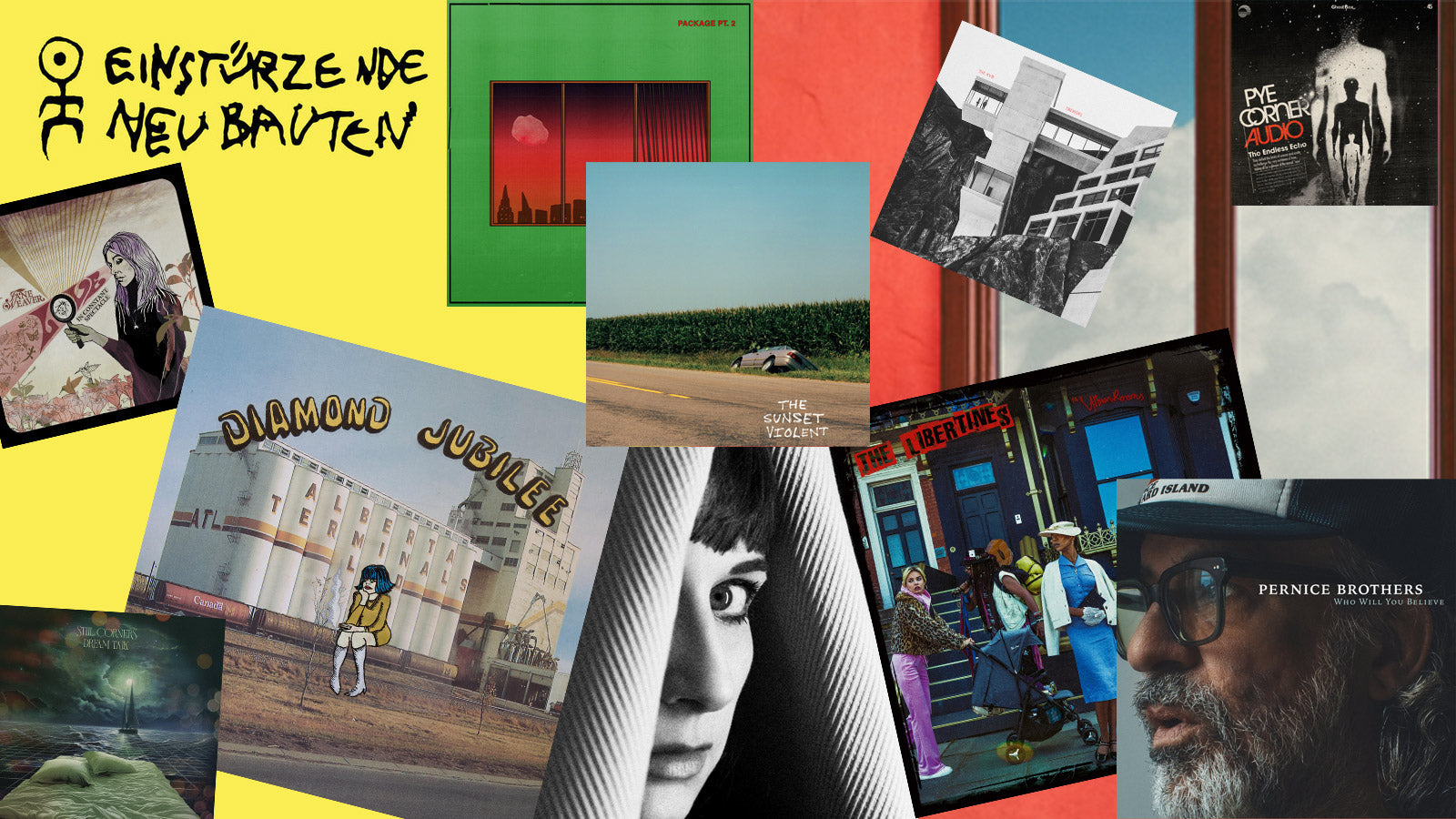
Some weeks there are maybe three or four new albums out that fall under the Indie Basement banner. Then there are weird weeks like this where it’s an absolute avalanche. Today we’ve got 13 records — including The Libertines, Cindy Lee, Mount Kimbie, Pernice Brothers, Khruangbin, Einstürzende Neubauten, Jane Weaver, Gustaf and Duchess Says singer Annie-Claude Deschênes — and a few of them have a good shot of making my Year End list in December. With so many titles, I tried to keep my reviews compact and with as few parenthetical diversions as possible. You’re welcome!
It’s not quite as big a week in Notable Releases where Andrew listens to the latest from Vampire Weekend, Phosphorescent, Wisp, and more.
You can catch up on last month with the Indie Basement Best Songs and Albums of March. and look forward to BrooklynVegan’s most anticipated spring albums.
Head below for this week’s baker’s dozen of reviews….

ALBUM OF THE WEEK #1: Cindy Lee – Diamond Jubilee (Realistik)
Despite being just over two hours long, this is Patrick Flegel’s most fully-realized, inviting Cindy Lee album yet.
Patrick Flegel hasn’t released a Cindy Lee album since 2020 (when they released three albums) but has clearly been busy. Diamond Jubilee is a two-hour and two-minute magnum opus that encompasses a wide variety of styles that showcase Flegel’s many talents as a songwriter, musician and producer. It’s a lot to take in. The album was originally announced as triple album Darling of the Diskoteque to be sold on tour, but then last weekend dropped as a pay-what-you-can download on Cindy Lee’s geocities site, renamed and resequenced as a theoretical double CD (wav files). I’m really only beginning to digest everything, but am also very wowed by it all. While still very much in the Cindy Lee lo-fi dreamworld of early-’60s pop, country and rock n’ roll, there are less weird-for-weird’s-sake sonic tapestries and instead a parade of memorable song after memorable song.
Lyrically these are mostly straightforward tales of longing, love and heartbreak — “Dreams of You,” “All I Want is You,” and “Always Dreaming” all come within a few tracks of each other on the first disc — which fit perfectly with Flegel’s love of Everly Brothers and Phil Spector productions. Though there are plenty of what I call “Lady in the Radiator” moments, Flegel is not singing all high falsetto this time, and the variety makes Diamond Jubilee a richer, more listenable experience and the daunting runtime sail by. It’s also the most guitar-oriented Cindy Lee album yet, and a real showcase for Flegel’s skills in that department; there are moments with gorgeous filigree throughout that are not that far from what you might hear on a Khruangbin album, just used to very different ends. Diamond Jubilee is a world that is easy to give yourself over to, despite length, and is peppered with amazing moments even very deep into its 32 songs, like the elegiac, stunning “What’s it Going to Take?” I have a feeling more sonic revelations will present themselves as this incredible record stays in my rotation throughout the foreseeable future.
—

ALBUM OF THE WEEK #2: Mount Kimbie – The Sunset Violent (Warp)
The former UK electronic duo are now a full-blown indie rock band, and a very good one at that
Despite being signed to Warp Records, having participated in the acclaimed DJ Kicks mix series and regular appearances on electronic music festivals, London’s Mount Kimbie have never been ones to be pinned down. They’ve long collaborated with King Krule, and since 2017’s Love What Survives they’ve sounded more like a band than other UK electronic duos of which there are many. For their fourth studio album, founding members Dominic Maker and Kai Campos have, with the addition of Andrea Balency-Béarn and Marc Pel, turned Mount Kimbie into an indie rock band, albeit one that is still very interested in all manner of electronics; The Sunset Violent is one of the more unique, surprising, and memorable pop records of the year. Making time in their busy schedules of working with Rosalia, slowthai, and James Blake, Maker and Campos decamped to the deserts of California’s Yucca Valley in 2021 to work on songs. It was there they found a newfound love of guitars, the classic ’80s Linn Drum machine, and the endless vistas of the desert. “I think when you see the horizon just go on forever, it does something to your brain that creates space for ideas,” Campos told Grammy.com. “It’s definitely the most American record we’ve made.” King Krule is back again, collaborating on the moody “Boxing” and motorik closer “Empty and Silent,” but Archy Marshall’s influence can be felt all over the album, especially on hazy single “Shipwreck” that’s driven by melodic and mutated bass. What makes this album so special is the way Mount Kimbie blend guitars and electronics into something that doesn’t quite sit in either world, as gleaming chords sheer off into distorted fragments and melt into the keyboards. The very best songs here, “Figure in the Surf” for example, are an android-like hybrid that owe a little to early-’80s proggy art-pop practitioners like Bill Nelson and Japan. Elsewhere, songs like “Yukka Tree” have more than a whiff of shoegaze to them, but Mount Kimbie fold it all into the distinct sound of this fascinating, engrossing album.
—

ALBUM OF THE WEEK #3: The Libertines – All Quiet on the Eastern Esplanade (Casablanca / Republic)
Across 20+ years and countless troubles, The Libertines’ genuine cameradie shines through on their fantastic fourth album
What’s the bigger surprise? That Pete Doherty is still with us or that The Libertines have released a record as great as All Quiet on the Eastern Esplanade. The band, led by best mates Doherty and Carl Barât, somehow survived the magnifying glass spotlight of the early-’00s indie renaissance where they were a genuine sensation (and source of many tabloid headlines) in England. Not unscathed; Doherty’s very public battles with drug addiction led to his split from the group, who officially broke up in 2004 not long after releasing their second album. Ten years later, Doherty and Barât patched things up and, with fellow bandmates John Hassall and Gary Powell, reformed The Libertines and released comeback album Anthems for Doomed Youth in 2015. That record was pretty good, but All Quiet on the Eastern Esplanade finds the likely lads older, probably wiser, but sounding very much like the Libertines you remember.
The band recorded the album over a four-week period in early 2023 with producer Dimitri Tikovoï (The Horrors/Charli XCX) at Doherty’s Albion Rooms studio in Margate, UK. “We really came together as a band,” said Doherty. “It was a moment of rare peace and unity, with all the members contributing.” Barât adds, “Our first record was born out of panic, and disbelief that we were actually allowed to be in a studio; the second was born of total strife and misery; the third was born of complexity; this one feels like we were all actually in the same place, at the same speed, and we really connected.” It really does, with the band’s swagger, camaraderie, lyrical style that intertwines band lore with tales of early 20th century England, and Doherty and Barât’s unique interplay. It’s not the shambolic party that Up the Bracket was, but who would want it to be with the band in their 40s. The songs are uniformly great and distinctly Libertines-esque, even when drenched in horns and strings. All Quiet on the Eastern Esplanade is their best since their first.
—

Pernice Brothers – Who Will You Believe (New West)
Neko Case and a string section enliven the best, most inspired Pernice Brothers albums in two decades
Few songwriters today imbue frustration and anguish into the sweetest of melodies as Joe Pernice. It’s a winning combination and as leader of Pernice Brothers since 1998, Joe has wrapped his darkest thoughts in music that references Jimmy Webb, The Left Banke, Big Star and Bread. He’s not all doom, gloom and self-loathing, but usually any hope in a song is tempered with a little despair. (He grew up a Smiths fan and was a colleague of late Silver Jews frontman David Berman, it all makes sense.) “I fell in love with the possible world,” Joe sings on the title track of Who Would You Believe. “Then I smashed my heart against the stones.” Joe’s musical output slowed to a trickle by the late-2000s but like a lot of artists, pandemic lockdown and the world events of the last four years rekindled a spark. You can feel that in what is the best, most inspired, most Pernice Brothers-y album we’ve gotten in more than two decades. It’s also the group’s first for Nashville label New West after 25 years self-releasing records on Pernice’s own Ashmont label. Having a budget for things like a string section — such a huge part of Pernice Brothers’ 2001 masterpiece Overcome by Happiness — makes these already great songs soar just a little higher. Who Will You Believe is also a bit of a Pernice Brothers Greatest Hits, with weepy acoustic ballads, sunshine pop, seething screeds against fallen idols wrapped in a bubblegum chorus, a fantastic duet with Neko Case, and Joe’s new wave youth rears its head on the anthemic “Hey, Guitar.” The album ends with its most affecting song, “The Purple Rain,” a heartfelt tribute to friends lost (Berman, Rhino Records founder Gary Stewart and Pernice’s cousin Joe Harvard [who founded Fort Apache Studios]) where, for once, the music is sad as the words, and when the strings kick in as Joe sings “I remember you” even the driest eyes may well up.
—

Khruangbin – A LA SALA (Dead Oceans)
The Houston trio’s chillest album yet, and all the better for it
I don’t spend a lot of time hanging out in fancy hotel bars these days but for whatever reason I did back in the late ’90s. (Tribeca Grand and Soho Grand in particular.) It was the era of chillout and you couldn’t go through a hotel lobby (or hair salon) without hearing Kruder & Dorfmeister’s K&D Sessions or Air’s Moon Safari, records that I own and like (or love, in the case of Air), but still associate with such spaces. Kruanghbin occupy that space now, at least to me, crafting very groovy, suave music that makes a perfect soundtrack to bespoke cocktails. Music that you’ll find your head bobbing to and maybe even Shazaming. A LA SALA doesn’t mess with the formula but is more successful than 2020’s vocal-heavy Mordechai by being even more chill and a return to their (mostly) instrumental ways. When they do sing, like on the wonderful “May Ninth,” it’s almost whispered or as if its coming from another room. Nothing on this album would wake a dog, but the performances are as skilled and nimble as they are hushed, like on standout “Pon Pón” which could redefine the term “silent disco.” The sheer unobtrusiveness of A LA SALA makes it highly replayable — I have let it repeat five or six times in a row more than once, partially because I forget, but also because I was digging it. Can a record be too chill? In this case, no, and what some might see as a bug, Khruangbin use as a feature. A LA SALA is enjoyable and engaging with or without a $17 negroni.
—

Jane Weaver – Love in Constant Spectacle (Fire Records)
Jane Weaver and producer John Parish are a match made in the stars on her 12th and best-sounding album yet
After years of making records more or less on her own, Jane Weaver tried something new for her 12th album — using a producer. Specifically, the very talented John Parish who is known for his collaborations with PJ Harvey, Sparklehorse, Aldous Harding, and more. Love in Constant Spectacle was made at Parish’s studio of choice, Rockfield in Wales, along with some time at Geoff Barrow’s Invada Studios in Bristol and, probably no surprise if your still reading this review, Weaver and Parish make for a very good match. The songs, as usual, are top notch, especially proggy opener “Perfect Storm,” the swaying, windswept “Romantic Worlds,” and the pleasingly precise “Is Metal.” Weaver is also still crafting cosmic folk from fuzzy guitars, old synthesizers and other vintage equipment but Parish brings a warm earthiness, a perfect balance between the organic and the synthetic, and lots of headroom in the mix for what might be her best-sounding record yet.
—

Gustaf – Package Pt 2 (Royal Mountain)
One of Brooklyn’s best live bands still haven’t quite figured out the studio on their second album
Gustaf went from being Brooklyn’s hardest working band to being the opener of choice for all manner of shouty UK indie bands on US tours, including IDLES and Yard Act. Good reason, too: Gustaf are amazing live and their songs are all designed for maximum audience engagement, from the funky post-punk rhythm section, to the call and response vocals and sloganeering choruses. Plus, the band are led by the very smart, funny and charismatic Lydia Gammill who you can’t take your eyes off of, nor should you; she might bound into the crowd and sneak up on you at a show if you’re looking at your phone. I still think there’s too much of their live aesthetic in their recordings, though. Those response vocals, pitched down a la Will Powers, come off a little gimmicky. I do however love “Happiest Thought,” which slides along a very slinky, synth-and-guitar-harmonics groove that sounds distinct from the rest of the album. I hope they play that one the next time I see them live, which I hope is soon.
—

Einstürzende Neubauten – Rampen (apm: alien pop music) (Potomak)
After a couple of stately, rather reserved albums, these industrial icons add some noise back for their 13th long-player
German industrialists Einstürzende Neubauten have come a long way from the days when they used live explosives and power tools at shows. Blixa Bargeld, Alexander Hacke and the rest of the group are now more likely to wear suits onstage, and records like 2020 Alles in Allem conjure adjectives like “dignified.” The band’s 13th album, Rampen: apm (alien pop music), however, brings back a little of the noise that made their name — which translates to “collapsing new cities” — so appropriate. What make their albums interesting is they’re often a direct repose to the previous one. In this case very directly, with songs starting as live improvisations — what they call a “rampen” — on their 2022 Alles in Allem tour and later honed in the studio. “On the album, I found a few solutions and formulated things in ways I haven’t formulated them before, because they were never so clear to me,” says Bargeld. “I follow the conviction. I’ll find something in the music that I didn’t know before. And sing something that I didn’t know.” It’s reassuring to know that this group featuring men in their mid-to-late-’60s are still willing to blow things up and start again, even if it’s just figuratively.
—

The KVB – Tremors (Invada)
Darkwave duo go widescreen for their latest album on Geoff Barrow’s Invada Records
UK duo The KVB call their new album “dystopian pop” which honestly I think would apply to everything they’ve ever released. Tremors is straight-up darkwave post-punk that borrows from the best: basslines from The Cure, synths and vocals from New Order/Joy Division, and the sweep (but not the bombast) of Sisters of Mercy. Nicholas Wood and Kat Day know how to construct satisfying, hooky songs and really understand genre sonics. On that note, Tremors is their biggest, best sounding record yet with a few curveballs in the mix, like the widescreen pop sheen on “In The Silence” and the sexy noir atmosphere and extremely satisfying chorus on “Overload.” There are no shortage of groups who sound like this, but few do it as well as The KVB.
—

Annie-Claude Deschênes – LES MANIÈRES DE TABLE (Italians Do It Better / Bonsound)
The Duchess Says singer argues French Canadians Do It Better on her new wave-y and very fun solo debut
This week might hold the record for sheer number of dark, synthy records in a single edition of Indie Basement. In addition to The KVB, Pye Corner Audio, and Einstürzende Neubauten — Jane Weaver and Still Corners fit in, too –we have the solo debut from Annie-Claude Deschênes who you may have experienced wreaking havoc as singer and mischief-maker for Montreal’s Duchess Says. LES MANIÈRES DE TABLE is, surprisingly, out via Italians Do It Better and while it’s much tamer than her band’s releases, this still has to be one of the most whacked-out, bangingest records the label has ever released. These nine tracks take French, English, new wave, electro, glam, minimal wave, techno, house and a variety of other electronic pop styles and drop them into a Cuisinart. There are vocoders, sampled orchestra hits, and endless rolls of electro-toms. There are moments that sound like Cyndi Lauper and others that could be an obscure synthave 7″ from 1980. LES MANIÈRES DE TABLE never lets up, is a lot of fun, and sounds great loud. “Manners” is not something I associate with someone who I’ve seen strike fear in an unsuspecting crowd member who somehow ended up at a Duchess Says show, but if Annie-Claude is hosting a dinner party, I want an invite.
—

Pye Corner Audio – The Endless Echo (Ghost Box)
More cinematic, phantasmagoric analogue synth music from Martin Jenkins
Martin Jenkins’ latest as Pye Corner Audio is another luxurious, otherworldly and cinematic trip through hazy atmospherics and darkwave beats, all powered by his amazing array of analogue synths. According to Ghost Box, whose label founder Julian House did another amazing sleeve design here, “this time around Jenkins draws inspiration from scientific and science-fictional notions about the nature of time and the idea that it may be entirely unreal.” I’ll have to take their word on that but there’s no denying The Endless Echo sounds eerie and fantastic.
—

Mei Semones – Kabutomushi (Bayonet)
Debut EP from this very talented singer-songwriter
Brooklyn singer-songwriter Mei Semones makes ethereal, folky indie rock that is jazzy, dexterous and string-laden with more than a dash of bossa-nova. Her debut EP is a real treat, showcasing an incredible amount of talent and firm grasp on a few different styles that she weaves togehter effortlessly. Kabutomushi opens with the rather dazzling tropicalia number “Tegami,” and from there heads to mathier but still sunny territory on “Wakare No Kotoba,” and even into ’90s indie rock on “Inaka.” The playing is muscular and nimble, and the string arrangements swoonworthy. I’m looking forward to hearing what Semones does next.
—

Still Corners – Dream Talk (Wrecking Light Records)
Sixth album from this UK dreampop duo doesn’t break any new ground but is expertly crafted
Much like Khruangbin, Still Corners have carved out a niche in the world of chilled-out music, though their style falls into drive-by-moonlight, lonesome road territory that sounds like the answer to, “What if Chris Isaak joined Mazzy Star, but they were English?” Dream Talk is the duo’s sixth album and if they’re not exploring any new territory here, they are expert drivers behind the wheel of a pristinely maintained ’60s convertible, piloting under a beautiful desert sky full of stars.
Looking for more? Browse the Indie Basement archives.
And check out what’s new in our shop.

Creation Records’ 21 Best Records


