
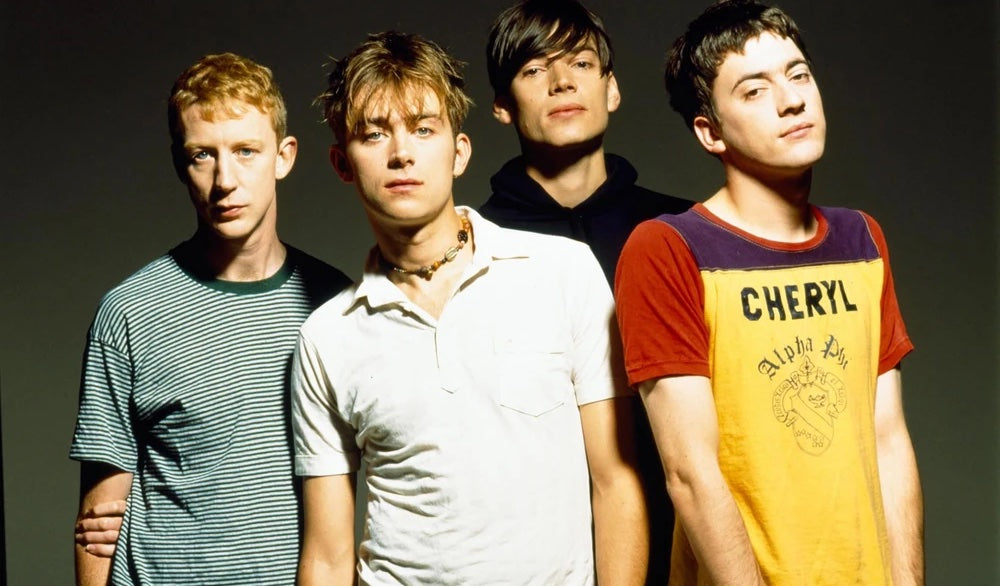
Few bands of the last 30 years have had more lives than Blur. Initially named Seymour, the band formed in London in 1988 and were very much a product of their time, with a four-letter name and just enough haze to fit in with the shoegazers (Lush, Ride), but also a danceable side that also drew from the baggy Madchester scene (Stone Roses, Happy Mondays) that was taking off at the time. But the group — frontman Damon Albarn, guitarist Graham Coxon, bassist Alex James, and drummer Dave Rowntree — shed most of that not long after their 1991 debut, and with their second album became one of the leading lights in the soon-to-be-huge Britpop scene. When that faded, they looked to America for inspiration, then electronic music, reinventing themselves more than once all while still managing to always sound like Blur.
Through “creative differences,” rehab, failing personal relationships, MP3, streaming, a myriad of scenes, wildly popular side projects, and long hiatuses, Blur have never officially broken up, making way for an extremely satisfying second (and third) act. With new album The Ballad of Darren out this week, we look back on Blur’s discography, ranking their nine studio albums. For a bit of silly British slang alliteration, our order is “from bollocks to brill,” but really Blur don’t have any bad albums and it’s impressive how even their outliers all fit nicely under their umbrella.
Your mileage may vary but head below for our Blur album rankings…

—

#9: Think Tank (2003)
Think Tank is not a bad album, in fact much of it is quite good, but it just doesn’t feel like a Blur album. Biggest reason for this: guitarist Graham Coxon quit early in the making of Think Tank and Blur just isn’t Blur without him. He is the sand to Albarn’s oyster that has produced so many pearls. For that and many other reasons, it was not an easy album to make, taking two years, three producers — Ben Hiller, William Orbit (who was behind the boards for 13), and Norman “Fatboy Slim” Cook — and lengthy stays at studios in England and Morocco. Add to this, Damon Albarn was coming off massive success with the first Gorillaz album, released just as they started working on Think Tank, and you can feel the pull of that project, as well as what he would do just a couple years later with The Good, The Bad, and The Queen. The best songs — “Running Out of Time,” “Good Song,” “Ambulance” — are the least Blurry, while the attempts to recreate the old magic (“Crazy Beat”) fall a little flat and haven’t aged well.
—

#8: Leisure (1991)
Blur hadn’t quite figured out who they were yet when they made their debut album. You couldn’t be a British guitar band in 1990-1991 and not be pulled into the “baggy” scene that mixed ’60s psychedelia with ecstasy-fueled rave, and Leisure bears that influence top to tail, from Graham Coxon’s flowery, wah-wah tinged guitar to Dave Rowntree’s syncopated, tambourine heavy drumming and Alex James’ melodic, groovy bass. Albarn’s thick London accent, and harmony style with Coxon, is the biggest through-line to the group they’d become. There are great songs here — “She’s So High,” the melodica-powered “Bad Day,” the sleepy “Repetition” (Coxon was sneaking in inventive riffs already), the majestic “Sing,” and the Stone Roses-esque hit “There’s No Other Way” — but you can feel the record company fingers on everything, determined to mold them into Smash Hits pin-ups with a sound that was falling out of fashion by the time the album was out.
—

#7: The Magic Whip (2015)
The Magic Whip, Blur’s first album in 12 years and first to feature Graham Coxon on the whole thing in 16 years, was a bit of kismet. The band, who had been playing live again since 2009, ended up stuck in Hong Kong in May 2013 after Japan’s Tokyo Rocks festival was canceled not long before it was set to start. Making the best of things, Blur booked time at Avon Studios and jammed for five days, recording everything. For a long time, nothing came of those recordings, but Coxon continued to have the urge to finish them. Coxon, producer Stephen Street (who worked on their first four albums), drummer Dave Rowntree, and bassist Alex James whipped the loose jams into songs which they then surprise-presented to Albarn, who then wrote lyrics and finished the record. Two years after the initial recordings, The Magic Whip was released. The impromptu nature of its creation clearly worked in their favor, as songs have an off the cuff charm, even if some of it is undercooked, be it jauntier numbers like “Lonesome Street” and “Go Out,” or melancholic creations “My Terracotta Heart” and “Mirrorball.” More than anything, it’s great to have Coxon back — not just his still-inspired guitar work but also his voice. With Street behind the board again, it feels like a real “getting the band back together” moment, with that old magic still intact.
—

#6: The Great Escape (1995)
After the one-two punch of 1993’s Modern Life is Rubbish and 1994’s Parklife, there was a lot of pressure on Blur to one-up themselves again while delivering more of the same. Of course, anything short of amazing was gonna be a letdown, and at the time this third serving of quirky British life felt like one Full English Breakfast too many. (Blur were sick of their own schtick by this point too, and would make an about-face with their next album.) But with the distance of nearly three decades, The Great Escape is better than you remember, from singalong hits “Stereotypes” and “Charmless Man” (one of the great Blur singles), to the swaying “Best Days” and bouncing “Top Man.” Blur and The Great Escape really excel at sweeping mood pieces and three of their best are here: “The Universal,” “He Thought of Cars” and “Yuko and Hiro.” Even the none-more-Blur “Country House” sounds pretty good now.
—

#5: The Ballad of Darren (2023)
Like The Magic Whip, Blur’s ninth album was born of unique circumstances. Offered the opportunity to play two huge shows at Wembley Stadium in July 2023, Blur wanted to make those shows all the more special with a new record. At the same time, Damon Albarn had written a batch of songs while on tour in America that didn’t quite fit in the Gorillaz or solo categories. He brought those songs to the rest of the band and, feeling the old Blur magic immediately, they recorded quickly with producer James Ford (Arctic Monkeys, Depeche Mode). The Ballad of Darren, which Albarn calls “the first legit [Blur] album since 13,” was announced just two weeks after they finished it. Opener “The Ballad” initially sounds like it could’ve been a solo Albarn song, and so do a few of the other melancholic ballads, but Coxon, James and Rowntree all bring their distinctive qualities to the record, adding up to that unmistakable, if mellowed, Blur sound. “St Charles Square,” is an instant classic, and the rest of the record — clocking in at a trim 36 minutes — is uniformly great, from the downcast pop of “Barbaric” and “The Narcissist” to the gorgeous, moving “Avalon” and “Goodbye Albert.” Albarn delivers some of his most personal, moving, introspective lyrics since 13, giving The Ballad of Darren a reflective swan song feel, but it’s so good let’s hope it’s not their last.
—

#4: Blur (1997)
It took them six years, but Blur finally cracked America with their self-titled fifth album — and monster single “Song 2” — but did so on their own terms. A lot was made about Blur’s embrace of Yank indie rock at the time: a Q cover story at the time opens with Blur attending a Pavement show in NYC and hanging backstage with the band and Sonic Youth and, adding to the lore, both this album and Pavement’s Brighten the Corners came out on the same day in the UK. But listening to the album now, 25 years on, it’s still very clearly, first and foremost, a Blur album. Albarn does not temper his English accent, nor does he make an attempt to alter his melodic style. Musically, “M.O.R.,” “On Your Own,” and “Movin’ On” could have been on any of Blur’s three previous albums with different arrangements, and “Look Inside America,” about Albarn’s love-hate relationship with the US, sounds like the cousin to Parklife‘s “End of the Century.” But the performances, arrangements, lyrics and production mark a new era for the group.
—

#3: Modern Life is Rubbish (1993)
Blur were “encouraged” by their American label to head out on a seemingly neverending 1992 US/Canada tour in support of Leisure, where they were met with indifference both at clubs and by alt-rock radio that had fully embraced grunge. When they finally got home, their response was to give up on America entirely (for the time being, at least) and embrace their Britishness. Working again with Stephen Street, who was in many ways the fifth member of the band for most of the ’90s, Blur dropped the baggy beats and shoegazy guitars and found inspiration in The Kinks, Bowie, The Smiths, The Beatles, Madness and other decidedly English groups (also: contemporaries Suede), while Albarn switched to an observational lyric style that drew from kitchen sink dramas and everyday British life. Modern Life is Rubbish is the sound of Blur discovering themselves and coming into their own. The songs are across-the-board great, from Bowie-esque singles “For Tomorrow” and “Chemical World” to the joyous pop of “Starshaped” and “Villa Rosie,” and the music hall-inspired “Sunday Sunday.” Coxon is shooting fireworks the whole time — the whole band is, really — and some of Modern Life‘s best cuts are the deepest, like the dreamy “Blue Jeans” which floats on clouds of melodica down London’s Portobello Road. Blur’s first great album but not their last, was also part of the opening salvo of Britpop: this, Oasis’ debut single, Suede’s debut album and Pulp’s breakthrough His N’ Hers were all released within two weeks of each other.
—

#2: 13 (1999)
Following the success of Blur, which finally brought them success in America, Blur once again found themselves at a crossroads. Damon Albarn had broken up with longtime girlfriend Justine Frischman of Elastica, his relationship with guitarist Graham Coxon had been better, and he had planted the seeds for Gorillaz after meeting, and moving in with, illustrator Jamie Hewitt. Meanwhile, Coxon was having his own problems beyond interband relationships, primarily with alcohol. With all this, and the creative freedom three #1 UK albums in a row brings, Blur decided to switch things up for their sixth long-player. Majorly. They parted ways with Stephen Street, who had produced all of their previous albums, and chose to work with electronic musician and producer William Orbit who had reworked “Movin’ On” for their Bustin’ + Dronin’ remix album, and who had just helped Madonna reinvent herself once again on Ray of Light. They decamped to Iceland where there were few distractions and ended up with the wildest, loosest, most varied and personal album to date. There are everything from devastating breakup songs (“Tender,” “No Distance Left to Run”) to odes to trainers (“Trimm Trabb”), as well as experiments with electronics that don’t sound like they’re being scene tourists. Orbit helps them blow up their sound, allowing them to be bigger yet more intimate than ever before. It’s also got the wonderful Graham Coxon-sung “Coffee and TV,” one of their best-ever singles, and “Trailerpark” which is clearly a trial run for Gorillaz. Messy, dark and overlong? Yes, but Blur needed all 13 songs (and 66 minutes) to work through their issues, and they turn even the not-entirely-successful sonic experiments into essential listening.
—

#1: Parklife (1994)
Energized by the creative and critical success of Modern Life is Rubbish (it sold well too), Blur knocked it out of the park with their third album that, along with Oasis’ (What’s The Story?) Morning Glory and Pulp’s Different Class, are the three pillars of Britpop. Parklife beat the other two by a year and turned Blur into superstars in their home country, thanks to four fantastic and very different hit singles: cheeky, infectious disco number “Girls & Boys,” the swaying “End of a Century,” the loungey “To the End” (featuring Stereolab’s Laetitia Sadier), and the iconic title track that sports lead vocals by Quadrophenia star Phil Daniels and instantly became the band’s signature. Really, though, Blur could do no wrong at this point and the album is all hits, encompassing Scott Walker-esque orchestral balladry (“This is a Low,” the album’s best song), folky psychedelia (Coxon’s “Far Out”), melancholic pop (“Badhead,” the album’s second best song), baroque (“Clover Over Dover”), kitschy novelty (“Lot 105”), and even punk (“Bank Holiday”), all of it performed with panache, dazzling musicianship and wit. Add one of the best album covers of the ’90s and you’ve got a perfect record.
—
Check out more of our Blur coverage.
See also: The 20 Best Britpop Albums of 1995