
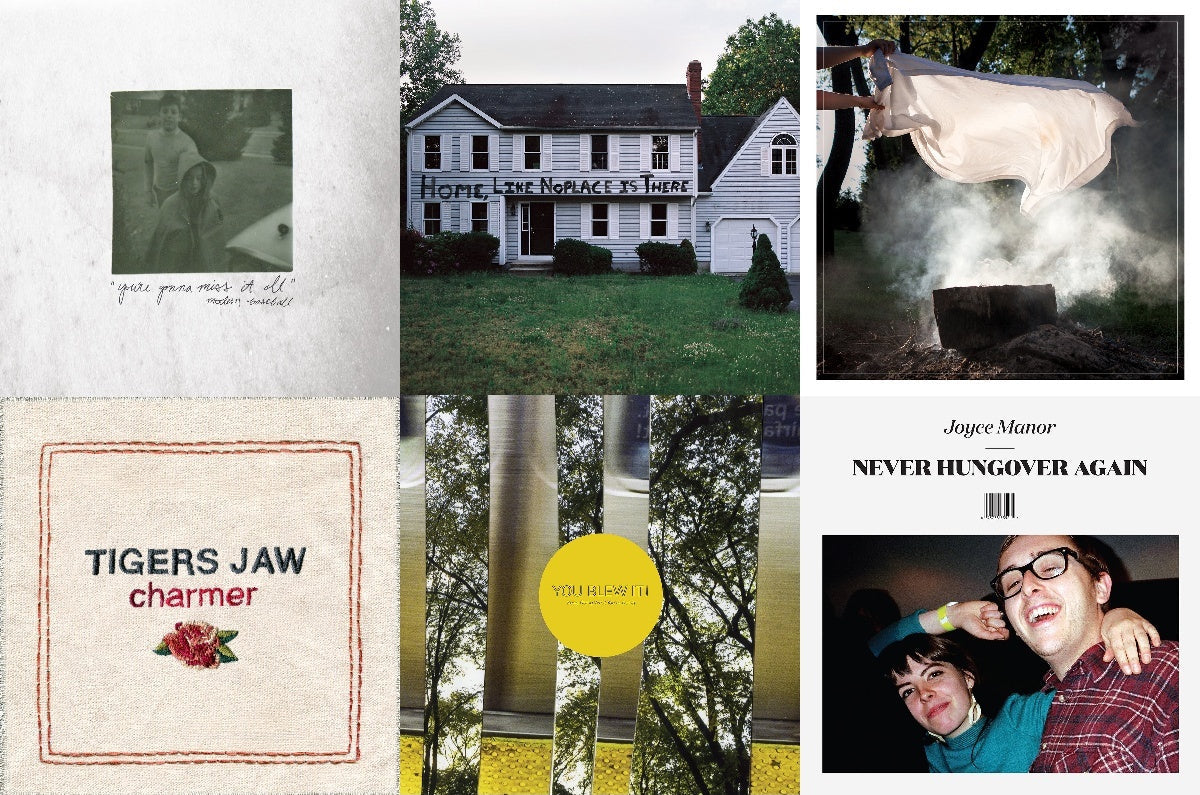
Last year, when we looked at 25 emo & post-hardcore albums from 2013 in honor of their 10th anniversaries, it was abundantly clear that this type of music was on fire in 2013, with one now-classic album after the next. That energy carried over into 2014, which birthed even more classics in and around these genres, and often even bigger ones. 2014 will probably go down as the year of Peak Emo Revival, and the music happening under that increasingly wide umbrella that year was some of the best of that whole era. We’ve now made this new list to celebrate the 10th anniversaries of many of those 2014 albums.
This list has 30 albums (five more than last year, and even narrowing it down to 30 meant leaving off a bunch of great ones), and a lot of them are inarguably emo or post-hardcore, whereas others are indie rock or pop punk or hardcore or metalcore or some other related subgenre. It’s less fun to get hung up on genre than it is to bend rules and incorporate bands from adjacent music scenes that scratch a similar itch.
Here’s the list, presented in chronological order…

Sport – Bon Voyage
Kiss of Death (US) (and like 20 other labels worldwide)
One of the best marriages of Northeast and Midwest-style emo in the 2010s came from Lyon, France. Sport were clearly absorbing a healthy diet of mid ’90s emo and late 2000s emo revival, and on 2014’s Bon Voyage, they beat so many of their US counterparts at their own game. If you’ve never heard it, picture Title Fight injected with Kinsella riffs, or a more throat-shredding Grown Ups, and you’ll be on the right track. The various ingredients are familiar, but Bon Voyage combined them in ways that felt (and still feel) fresh, and their huge choruses were impossible to stay away from.

You Blew It – Keep Doing What You’re Doing
Topshelf
Keep Doing What You’re Doing was one of those real stars-aligning moments. They’d already sharpened their ’90s-emo-reviving tools by their 2012 debut LP Grow Up, Dude, and on this album, they took things to a new level, with songwriting that stood tall next to the actual ’90s bands they took cues from. It was produced by Evan Weiss of Into It. Over It., who at that point had basically become a veteran of Midwest-style emo himself, and they brought the best out of each other–You Blew It! reminded Evan of his own early days and Evan helped make You Blew It! sound really fucking good. Keep Doing What You’re Doing came out right after emo revival became the subject of a ton of major publications’ listicles and thinkpieces (Stereogum named them one of 12 bands to know from the emo revival three months before the album’s release), and it was released on Topshelf, who at that point was at the forefront of this entire wave of music. You Blew It! were definitely in the right place at the right time, but even more importantly, they wrote a really great record that still stands the test of time. Grow Up, Dude was a delightfully scrappy record that was written to be played in basements, but You Blew It! knew this time they’d be reaching wider audiences and playing bigger stages, so they really allowed themselves to lean into the subtle, intricate details that get lost when you’re playing through a shitty PA at a basement show. And on top of that, Tanner Jones was really writing real-deal hooks. ’90s emo wasn’t just the cacophonous noodling of Cap’n Jazz and Braid–it was also bands with real pop sensibilities like The Promise Ring, Knapsack, and The Get Up Kids, and on Keep Doing What You’re Doing, You Blew It! emerged as worthy heirs to both.

Against Me! – Transgender Dysphoria Blues
Total Treble
Maybe not exactly emo or post-hardcore, but Against Me! influenced and then toured with so many “emo revival” bands, and it’s impossible for me to think about this sphere of music in 2014 and not think about Transgender Dysphoria Blues. Laura Jane Grace publicly came out as a transgender woman in 2012, went on a solo tour in 2013 playing songs she’d written for this album, and in January of 2014, the world was finally introduced to Transgender Dysphoria Blues. It found Laura opening up about a large part of her life story that she’d struggled with privately for so long, and it also happened to be the best album she’d ever written. It reinvented Against Me!’s career on so many different levels, and it opened the band up to new audiences who had never opened a copy of Reinventing Axl Rose. It still lands with impact when you hear Laura sing about how “you want them to see you like they see every other girl,” or about how “you should be living a different life,” or when she opens up about other struggles like grieving for a friend who lost his life at the young age of 26, and all of the deep vulnerability culminates in hooks that you want to scream back in Laura’s face.

Modern Baseball – You’re Gonna Miss It All
Run For Cover
Modern Baseball’s friend and manager Eric Osman started a record label, Lame-O Records, just to put out the band’s 2012 debut album Sports because no other label showed any interest. Less than two months later, Sports had stirred up so much buzz that Modern Baseball got an offer from Run For Cover, and when they released their RFC debut You’re Gonna Miss It All the following year, they became RFC’s fastest growing band. It all happened organically and it happened because people loved the band so much. They were fun and funny on stage and on their records, and they were unapologetically themselves–a group of lovably goofy kids who were tired of everyone taking themselves so seriously. They brought all that energy with them into You’re Gonna Miss It All, and they also refined their craft in every way possible. Bassist Ian Farmer hit studied up on engineering, and the band handed it off to Jon Low (The Menzingers, The National) to mix. They channeled their love of scrappy, Weakerthans-y folk-pop-punk into concise anthems like “Fine, Great,” “Broken Cash Machine,” “Rock Bottom,” and “Charlie Black,” and they balanced out the bangers with somber bedroom folk (“Timmy Bowers,” “Pothole”) and alt-country (“Notes”). And to top it all off, they wrote their signature song, “Your Graduation.” Co-leader Bren Lukens tackled coming-of-age anxieties with one shoutalong one-liner after the next, and drummer Sean Huber stepped in to sing the iconic third verse, making for the most explosive moment at every Modern Baseball show for the remainder of the band’s existence.

The Hotelier – Home, Like Noplace Is There
Tiny Engines
Home, Like Noplace Is There really marked a shift in 2010s emo in a way that very few other albums in that era did. The Hotelier weren’t the most popular band in the genre (and still aren’t), but Home, Like Noplace Is There really embodied what separated this new generation of emo from the previous one. It raised the bar for so many of the band’s peers and even their forebears, and there’s still no other emo album before or since that sounds like it. Having started out as more of a pop punk band with a slightly different lineup and a slightly different name (The Hotel Year), the band’s 2011 debut LP just barely hinted at what they would become on Home, Like Noplace Is There. For this album, singer/bassist Christian Holden took the reigns and handled most of the songwriting themself. The music channels everything from the off-kilter emo-pop of Piebald and Weatherbox to rollicking folk punk (“In Framing”) to screamo (“Life In Drag”), and the overarching theme of the album takes an emo trope that’s been stereotyped to death–singing about one’s hometown–and really explores it on a deep level. It looks beneath the surface at the abuse, addiction, gender dysphoria, depression, and suicide that fuels suburban malaise, with elaborate, detailed lyricism. It’s music that never feels tailored to neat refrains and crowd singalongs, but the band’s pop sensibilities were so strong that crowds would come to The Hotelier’s shows and yell every word. The band used to open their shows in this era with the album’s especially wordy, chorus-less opening track “An Introduction to the Album,” and those singalongs were just as loud as the ones for the more anthemic songs like “The Scope of All This Rebuilding” and “Your Deep Rest.” On both a musical and a lyrical level, Home felt like a clear step forward for emo and it helped set the tone for the next decade-plus of bands in this genre. It’s easy to see how the band’s genre-defiance and socially conscious lyrics paved the way for a newer band like Home Is Where to thrive, and Home, Like Noplace Is There still sounds fresh next to all the music that’s come in its wake.

Owls – Two
Polyvinyl
Of all the influential ’90s emo bands that made new music during the 2010s emo revival era, Cap’n Jazz was not one of them… unless you count the fact that all four original members returned with the first album in 13 years by their post-Cap’n Jazz band Owls. Owls never had quite the same aura around them as Cap’n Jazz, but it’s Tim Kinsella on vocals, Mike Kinsella on drums, Sam Zurick on bass, and the virtuosic noodling of Victor Villareal on guitar, and you can hear the influence of their 2001 self-titled debut album on emo revival just about as much as you can hear Shmap’n Shmazz. Obviously the scrappiness of Cap’n Jazz has its charms, but Owls was tighter, more tuneful–while still being totally eccentric–and there’s a lot to be said for that too. On Two, Owls sounded even weirder than they did on the first LP, and they didn’t just come back to rehash the past. There’s some of that classic Victor Villareal noodling, those delightfully off-key Tim Kinsella vocals, and plenty of the unmatched chemistry that comes from these four playing together, but the vibe is more brooding and mysterious. They definitely didn’t come back to capitalize on the renewed interest in the type of music these four made together 20 years earlier; they came back because they had something new to say, and what they had to say was out of step with almost everything happening around them, just like their ’90s bands were.

Fireworks – Oh, Common Life
Triple Crown
Last year, Fireworks made a big comeback with Higher Lonely Power, an ambitious art pop album with almost no trace of the band’s pop punk roots. It’s a drastic departure from anything else they’ve ever done, but it also reminds you that Fireworks were never a typical pop punk band in the first place, especially not by the time of their final pre-hiatus album, Oh, Common Life. Like their close friends The Wonder Years, they came at pop punk with literary references, social awareness, and a wide palette of musical influences, and they’d often put those things front and center: their first album has songs called “Geography, Vonnegut and Me” and “I Support Same Sex Marriage,” and this one has a song called “Play ‘God Only Knows’ At My Funeral.” And even without titles like that, it comes through in the music that the band is wise, well-read, and open-minded. Oh, Common Life is a pop punk album, but it also has a lot of slower tempos, softer moments, warm organic production (courtesy Brian McTernan), and some classic pop and rock & roll influence. David Mackinder also never had a typical pop punk voice, and his unique style is a big part of what separated Fireworks from their peers. Oh, Common Life opens with one of Fireworks’ most immediate bangers (“Glowing Crosses”), and it goes off into all kinds of different territories, from the snappy pop rock of “Bed Sores” to the towering power ballad “One More Creature Dizzy with Love.” On “Run, Brother Run,” David opens up about his father’s death, which occurred in April of 2011 in the leadup to Fireworks’ previous record, Gospel. It’s one of his most personal songs, and it still induces goosebumps 10 years later.

La Dispute – Rooms of the House
Better Living Staple
When your first album is a genre-defying concept album based on a historic folktale with a 12-minute song, doing something a little more stripped-back and straightforward is actually a pretty unorthodox move. That’s what La Dispute did on their third record, Rooms of the House, which remains an anomaly in the band’s catalog. It was their first album recorded with Will Yip, and it finds the band moving away from the progressive/art rock-infused post-hardcore of their first two LPs into more of a hardcore-informed indie rock territory, almost like La Dispute’s answer to Fugazi’s The Argument. It’s warmer, calmer, and simpler, but Jordan Dreyer’s lyrics are just as intricate and in-depth as ever. The whole album tells a single fictional story about a separated couple that once lived together, and–true to the album title–the story is often told through memories sparked by inanimate objects in the house. And though it’s fiction, it also pulls details from the lives of Jordan’s own family members, so it hits close to home even though it’s never as autobiographical as the first-person songs may seem.

Somos – Temple of Plenty
Tiny Engines
On their debut LP Temple of Plenty, Boston’s Somos made indie rock-infused emo (or emo-infused indie rock?) that really didn’t sound like any of their peers, and it still stands out as a unique gem within both genres. They’ve got a ton of energy, crisply-distorted guitars, and a very distinct vocalist in Michael Fiorentino who never sounds like a typical emo singer. They’ve also got songs that hit you like a ton of bricks and still sound fresh 10 years later. Exact subgenre aside, Temple of Plenty was just some of the strongest rock songwriting of its time–the kind of unabashedly big, loud, melodic songwriting that would’ve landed on the radio 20 years earlier.

Cloud Nothings – Here and Nowhere Else
Carpark
After 2012’s Attack On Memory turned Cloud Nothings from a fuzzy lo-fi project into a forceful post-hardcore band, Here and Nowhere Else doubled down on the promise that this was going to be the version of the band we’d hear going forward. (Today in 2024, that’s still true.) It shares a lot of traits with Attack On Memory–the bright hooks, the jagged edges, the lengthy noise rock freakout (“Pattern Walks”)–but it’s also a clear step forward. John Congleton’s production style is a lot different than Steve Albini’s work on Attack, you can hear the effects of the busy Attack On Memory tour cycle on Cloud Nothings’ tightness and confidence, and Dylan Baldi’s songwriting clearly progressed in the two years between LPs. Every song on Here and Nowhere Else is a winner, and even if Attack On Memory probably still goes down as Cloud Nothings’ most important album, Here and Nowhere Else‘s closing track “I’m Not Part of Me” is their most enduring single.

Manchester Orchestra – Cope
Loma Vista/Favorite Gentlemen
After releasing their most ornate-sounding album on 2011’s Simple Math, Manchester Orchestra returned with some big-ass rock riffs on 2014’s Cope. Even more so than 2009’s grungy Mean Everything to Nothing, this might just be the most purely hard-hitting Manchester record, and seeing the Cope songs live is always a major highlight. It’s also admittedly unfair to paint this just as a riff rock record, as it’s got plenty of slower, softer moments that remind you Andy Hull is a singer/songwriter at heart. (They also released an acoustic re-imagining of this album called Hope that really reminds you of that.) There are riffs here that could be on Mastodon records, but Andy’s singing and songwriting style turns them into something else entirely. Like just about every record by this band, Cope defies easy categorization.

The Menzingers – Rented World
Epitaph
The Menzingers’ 2012 album On the Impossible Past will probably always go down as the band’s most classic album and most significant breakthrough, but the truth is, OTIP‘s rise was a very slow one. The Menzingers didn’t really jump up in popularity until they released its 2014 album followup Rented World. Rented World probably owes some of its success to the band just having more of a spotlight on them in 2014 than they did in 2012, but it also probably didn’t hurt that bangers like “I Don’t Wanna Be An Asshole Anymore” and “In Remission” were and still are some of the band’s most instant crowdpleasers. In the time since OTIP, The Menzingers had started bringing a little more of a grunge influence into their heartland punk anthems, and producer Jon Low (who also worked with their friends Restorations and bigger indie bands like The National and The War On Drugs) was a great match for Rented World‘s wall-of-sound guitars. Trademark Menzingers rippers show up in the form of “My Friend Kyle” and “The Talk,” but one of the album’s most memorable songs is a lovelorn ballad called “Where Your Heartache Exists.” Everything’s bigger on Rented World: the production, the guitars, the band itself, and the feelings.

Frameworks – Loom
Topshelf
The thing about screamo is it’s always a good time for screamo. Even when you’re not hearing as much about it out in the open, it’s always there, lurking in the background. But when you are hearing about it out in the open, there are usually some pretty exciting reasons why. The mid 2010s was one of the most visible periods for screamo thanks to the popularity of bands like Touché Amoré and Pianos Become the Teeth, and Frameworks were a slightly newer band that helped carry that same torch. Their 2014 debut LP Loom is harshly-shrieked, ’90s-style screamo with expansive post-rock climaxes, polyrhythmic freakouts, and other elements that make this record a towering listen. The album’s recorded in a loud, speaker-busting way where it always sounds like it’s kinda clipping, but it’s also a majestic-sounding record and that’s largely thanks to the songwriting and musicianship itself. Screamo’s having another moment as we speak (thanks to the Orchid and Saetia reunions coinciding with the popularity of new bands like Vs Self), and if you’re a screamo fan that hasn’t heard Loom yet, there’s no time like the present to change that.

Weatherbox – Flies In All Directions
Triple Crown
Weatherbox’s 2009 album The Cosmic Drama feels like one of those ‘great album at the wrong time’ cases. It’s a raw, strange album that sounds like if Piebald and Say Anything got together to try and remake Pinkerton, and it’s one of those records that if you know it, you love it, but you probably don’t know it. As is often the case with outlier bands like this one, some of Weatherbox’s fans formed bands of their own–their influence is easy to hear on bands like The Hotelier and Oso Oso–and as bands they inspired were starting to leave their mark, they made a big comeback with 2014’s Flies In All Directions. It’s a much more streamlined record than The Cosmic Drama, but still a more eclectic one than their punkier 2007 debut American Art. It felt like it tied up The Cosmic Drama‘s loose ends, and at this point it’s a cult classic of its own. Also, bonus points for Manchester Orchestra’s Andy Hull giving one of his best guest appearances on “The Devil and Whom?”.

Tigers Jaw – Charmer
Run For Cover
Charmer is a rare record that marked the end of an era, but it also opened the doors to a fruitful new one. It was recorded after founding co-vocalist Adam McIlwee and the rhythm section of Dennis Mishko and Pat Brier had already decided to leave the band, but even with 3/5 of the band already checked out, Tigers Jaw gave it their all. Adam contributed some of the best songs he’d ever written like “Cool, Charmer,” and “Slow Come On,” and he’d developed a moodier, more brooding delivery that paired perfectly with lines like “It’s a cruel world but it’s cool” and “I was getting bored of the compliments”–darker, more apathetic sentiments than the teenage feelings on Tigers Jaw’s self-titled 2008 breakthrough. Co-vocalist Ben Walsh also stepped up to the plate with his best set of songs yet, and keyboardist Brianna Collins stepped into her role as Tigers Jaw’s new co-leader with a lead vocal turn on “Hum.” Even the departing Pat Brier, who wasn’t one of the lead singers, wrote and sang lead on the slow-burning standout “I Envy Your Apathy.” For an album that marked a band breakup, it was also the most collaborative Tigers Jaw album yet, and it was musically a clear step forward. Tigers Jaw went through a few different touring lineups as they supported it, and Charmer helped the band headline the biggest venues of their career and it launched as many fan-fave setlist staples as the self-titled.

Every Time I Die – From Parts Unknown
Epitaph
Every Time I Die already stood out from the 2000s metalcore pack during their first decade as a band, and they spent the next 10-plus years maintaining a level of longevity that stood out from so many of their early peers. On From Parts Unknown, they teamed up with another lifelong metalcore innovator, Kurt Ballou of Converge, and delivered what was their heaviest, most abrasive album since 2003’s Hot Damn!, if not just their heaviest, most abrasive album ever. It’s rare to hear a band up the ferocity like this 15+ years into their career, let alone hear them do it so goddamn well.

Braid – No Coast
Topshelf
Before American Football became the ’90s emo comeback of the decade, Braid released their first album in 16 years and it fully re-established them as not just influential heroes but a current force within the genre. Braid-inspired bands were everywhere in 2014, and the actual Braid was right there with them. They signed to rising label Topshelf, made No Coast with rising producer Will Yip, and toured with a bunch of bands in the new generation. They were veterans, but they didn’t want to seem “old,” and they very much succeeded in that. No Coast sounds at least as lively as the music Braid made in the ’90s, and it stays true to their general form without sounding like something we’d heard from them already. These are fired-up, energetic songs, and some of the catchiest that Braid have ever written.

Joyce Manor – Never Hungover Again
Epitaph
Joyce Manor avoided the sophomore slump by releasing an album so erratic even the band seemed like they didn’t know what to do with it (2012’s Of All Things I Will Soon Grow Tired), but they kept rising in popularity because of their enduring 2011 self-titled debut, and when they signed to Epitaph, they decided to write the album that could really take them to the next level. And that’s exactly what Never Hungover Again did. It found guitarist Chase Knobbe writing more of his own lead guitar parts that interlocked with Barry Johnson’s songwriting, giving these songs a subtly off-kilter effect. It found them leaning into the influence of bands like The Smiths and Big Star, and embracing more of a mid-tempo vibe, without toning down their usual punk energy and without making any of their new influences too obvious. It had a warmer production style than any of their previous records, and it introduced vocal harmonies for the first time in Joyce Manor’s career. All these little intricate moments added a lot to the record, but on top of all of that, Joyce Manor just wrote one of the best batches of songs of their career. Like their debut, Never Hungover Again feels like a greatest hits. It’s got 10 songs in 19 minutes, and any single one of them would be a major crowdpleaser at any show. Whether you call it punk or emo or power pop or indie rock, this is just good songwriting.

Prawn – Kingfisher
Topshelf
Prior to Kingfisher, Prawn were writing ’90s/Midwest-style emo revival songs that sounded built for the basement. But by 2014, when the spotlight was pointed directly at this scene, Prawn swung for the fences and made a record that aimed at something much bigger. Right off the bat, on opening track “Scud Running,” they’re in spacious, mid-tempo territory with string and horn arrangements that sound grander than anything else they’d ever done. It sets the tone for the rest of the album, which finds them offering up post-rocky, math-rocky emo songs that are lush, memorable, and transcendent.

Punch – They Don’t Have to Believe
Deathwish
Punch were more in fast hardcore (and sometimes grindcore) territory than post-hardcore / screamo peers like Touché Amoré, Loma Prieta, and Comadre, but their darkness and sense of songcraft made them more in line with those bands than with hardcore traditionalists. Kind of like American Nightmare did in the previous generation, Punch found ways to innovate within hardcore without slowing down. Meghan O’Neil’s delivery is full of passion, and everything that the rest of the band is doing sounds crisp and intentional. Especially now in the 2020s that hardcore is in the midst of an especially open-minded, creative moment, They Don’t Have to Believe is a record that would fit in perfectly with the current scene (and definitely influenced some of the bands in it). It was Punch’s last album before Meghan formed Super Unison (with members of Pennsylvania emo/screamo bands Snowing, Street Smart Cyclist, Boy Problems, and more), and it was a very high note to go out on.

Empire! Empire! (I Was A Lonely Estate) – You Will Eventually Be Forgotten
Count Your Lucky Stars
Between running Count Your Lucky Stars and leading Empire! Empire! (I Was A Lonely Estate), the ’90s-style emo revival of the late 2000s and early 2010s never would’ve happened the way it did without Keith Latinen. With Empire! Empire!, he carried the torch for delicate, slowcore-ish, Mineral-inspired emo, and on the band’s final album You Will Eventually Be Forgotten, he delivered some of his most bluntly vulnerable songwriting ever. It came five years after Empire!’s debut LP (but with a billion split EPs in between), and it found Keith getting right into it, with spine-tingling one-liners like “I nearly lost you on our wedding day” and “I almost died at twenty-one.” It’s a cliché to say that emo songs are written like diary entries, but these really, really are, and Keith’s yearning, soaring delivery really adds to the impact. You Will Eventually Be Forgotten also united Keith with two of his biggest influences: Braid’s Bob Nanna sings a guest verse on “A Keepsake” and Mineral’s Chris Simpson harmonizes with Keith on album closer “The Promise That Life Can Go on No Matter How Bad Our Losses.”

Cayetana – Nervous Like Me
Tiny Engines
It’s not every day that a band hits it out of the park on the first swing like Cayetana did. Their three-song 2012 demo showed off a folky, energetic indie-emo band that was shambolic yet precise, and had an impactful singer/songwriter in Augusta Koch. They got signed to Tiny Engines off the strength of that demo, and less than two years later, they re-recorded two of those songs and nine others for their great debut LP Nervous Like Me. Like the demo, the LP doesn’t fit neatly into any genre–it’s got elements of indie rock, folk, punk, and emo, but it’s never just one of those things–and Augusta’s songwriting remains enduring a decade later. She’s the kind of songwriter who can say so much with so little (“The hardest part of moving out is I remember moving in”) and these choruses never leave your head once they’re drilled in.

Cymbals Eat Guitars – LOSE
Barsuk
Like Cloud Nothings, Cymbals Eat Guitars came more from the press-driven indie rock world than the emo/punk world, but they ended up traversing through this world and LOSE had a lot to do with that. I wouldn’t say it’s necessarily an emo record, but it arrived at a similar destination, and it shared enough traits that it made sense for Cymbals to support this record on tours with Brand New/Foxing and Say Anything/Modern Baseball/Hard Girls. After 2011’s sprawling, experimental (and often misunderstood/underrated) Lenses Alien, Cymbals leaned into big, loud, shout-sung choruses, punkier vibes, and a devastating level of lyrical vulnerability. LOSE found bandleader Joe D’Agostino opening up about the 2007 death of a close friend and former bandmate, with hyper-specific details that led to widespread relatability. It still has the weirder, more out-there moments that Joe’s songwriting has always been known for, like the proggy 8-minute “Laramie,” and those moments were just as important to LOSE as the digestible hooks. The combination of both is what made this band stand out from whoever people tried to group them with.

Hostage Calm – Die On Stage
Run For Cover
Hostage Calm could sort of feel that the end of the band was near when they were writing this album, but they didn’t realize how prophetic of a title Die On Stage would be. When they were supporting the album on tour with Citizen, they broke up mid-tour and headed home early without thinking twice. (They did briefly regroup for some triumphant farewell shows in 2015 though.) Maybe it’s because they never got to properly support the album, but Die On Stage feels like an album that never fully got its due. Every Hostage Calm album sounds different than the last, and this one found the melodic punk band diving into classic power pop, heartland rock, and rock & roll, and coming out with some of the warmest, brightest, catchiest songs of their career. Will Yip’s production is to thank for some of the warmth and ease in this record too. It’s a deceptively simple record where every song feels like an anthemic singalong and socially/politically conscious lyrics are woven into tracks that can sound like love songs on the surface. And, even if some of these elements sound like other records on paper, nothing else really sounds like Die On Stage in execution.

Kittyhawk – Hello, Again
Count Your Lucky Stars
Kittyhawk (whose members also play/played in Dowsing, Island of Misfit Toys, and other bands) have been compared to (and are openly influenced by) Rainer Maria a lot over the years, but on their sole full-length Hello, Again, they really transcended the comparison and became a true force of their own. The late ’90s / early 2000s emo vibes are fleshed out by banjo, acoustic guitar, organs, and some really gorgeous vocal harmonies. It also has a very modern, rich-sounding production style that helped Kittyhawk take their 15-20 year-old influences into the future. Listening to it 10 years later, it’s not hard to think of bands that this album helped lay the groundwork for.

Little Big League – Tropical Jinx
Run For Cover
The second and final album by Little Big League is sort of a sleeper pick within Michelle Zauner’s catalog. The band broke up before they could do a full tour behind it, and Michelle soon turned her full focus to Japanese Breakfast, but Tropical Jinx deserves to be revisited. It’s darker, weirder, and heavier than LBL’s 2013 debut LP These Are Good People and the way Michelle yells on it is a very cool touch. It’s more off-kilter punk and less emo than Good People, and it’s of course in much different territory than Japanese Breakfast. It’s not Michelle’s most accessible record, but that’s probably by design, and it’s very cool to hear a gem like this among the rest of her vast output.

Restorations – LP3
SideOneDummy
When Restorations formed out of the ashes of the screamy post-hardcore band Jena Berlin, the idea was for this band to have more a casual lifestyle–playing local, not doing as many big tours, hanging out and making records with their friends. The music was more relaxed too, channeling slower, more grizzled bands like Constantines and Lucero compared to the more abrasive sounds of Jena Berlin. But Restorations were too good to be ignored, and they ended up signing to SideOneDummy and becoming a full-time touring act. On 2014’s LP3, they swung for the fences more than ever. Working with producer Jon Low (The National, The War On Drugs), they came out with the biggest-sounding record of their career. It fuses together elements of punk, indie rock, post-rock, heartland rock, sludge metal, psychedelia, and more into something that’s uniquely Restorations, and it’s got the most memorable hooks the band has ever written. It’s also got some sentiments that hit even harder now than they did when LP3 came out. In a world that’s even more bogged down by social media than the world of 2014 was, “Imagine that focus in real life/Imagine going outside” carries even more heft than it did then.

Pianos Become the Teeth – Keep You
Epitaph
Pianos Become the Teeth had been gradually branching out from their screamo roots into melodic clean-sung territory on The Lack Long After closer “I’ll Get By” and even more so on “Hiding” from their 2013 split with Touché Amoré, but their Epitaph debut Keep You made the transition complete. It was closer to The National than to pageninetynine, without losing any of the intensity of Pianos’ more aggressive material. If anything, the less chaotic nature of the music and Kyle Durfey’s clean vocals made it so his words landed with even more impact, and Keep You is some of his most gripping, emotional, personal songwriting. The album largely deals with his father’s passing, and highly specific details like “I got your picture sitting on the sink/You were so young, so skinny, so quick to laugh” become even more widely relatable than overarching statements on loss and grief. It’s such a vocal-forward record that it might not immediately scan as “post-rock,” but that’s the territory that these towering, climactic, and disarmingly beautiful instrumentals most often fall in. It’s almost hard to remember that it once felt like a bold move for Pianos to make this stylistic change; at this point, Keep You is their definitive statement.

Chumped – Teenage Retirement
Anchorless Records
Chumped went from 0 to 100 after releasing their 2013 self-titled debut EP, a collection of fast, catchy, indie-pop-punk songs that were impossible to hear and not immediately love. Wasting no time, they wrote and recorded their first full-length, Teenage Retirement, the next year, and it made very good on the promise of the EP. The fast songs sound like the best parts of ’90s pop punk, and the slower moments vary between climactic emo and fuzzy Weezer worship. It’s a total blast, and singer/guitarist Anika Pyle’s songwriting is both personable and addictive. After Chumped broke up with two instantly-legendary farewell shows at the now-defunct Brooklyn emo house Suburbia, Anika went on to explore other styles of music with Katie Ellen and under her own name, and it’s all great (don’t miss out on this year’s country-leaning Four Corners EP), but it’s always a treat to revisit the revved-up punk territory of Teenage Retirement.

Forth Wanderers – Tough Love
self-released
Forth Wanderers eventually ended up on Sub Pop for their 2018 self-titled sophomore LP, but before that, they arrived fully-formed on their self-released debut LP Tough Love. It falls somewhere between ’90s emo and ’90s indie rock, with off-kilter guitar patterns and a somber delivery from vocalist Ava Trilling, but it also sounded totally of its time in the mid 2010s. This was the era when bedroom pop and louder guitar rock were starting to cross paths a lot, and there’s still a lot of music coming out today that feels indebted to–or at least similar to–this record. It’s intimate and scrappy but there’s a lot going on beneath the surface, and Ava’s melodies and deceptively apathetic singing style really hits.
—
PREVIOUSLY: 25 Classic Emo & Post-Hardcore Albums Turning 10 in 2023