
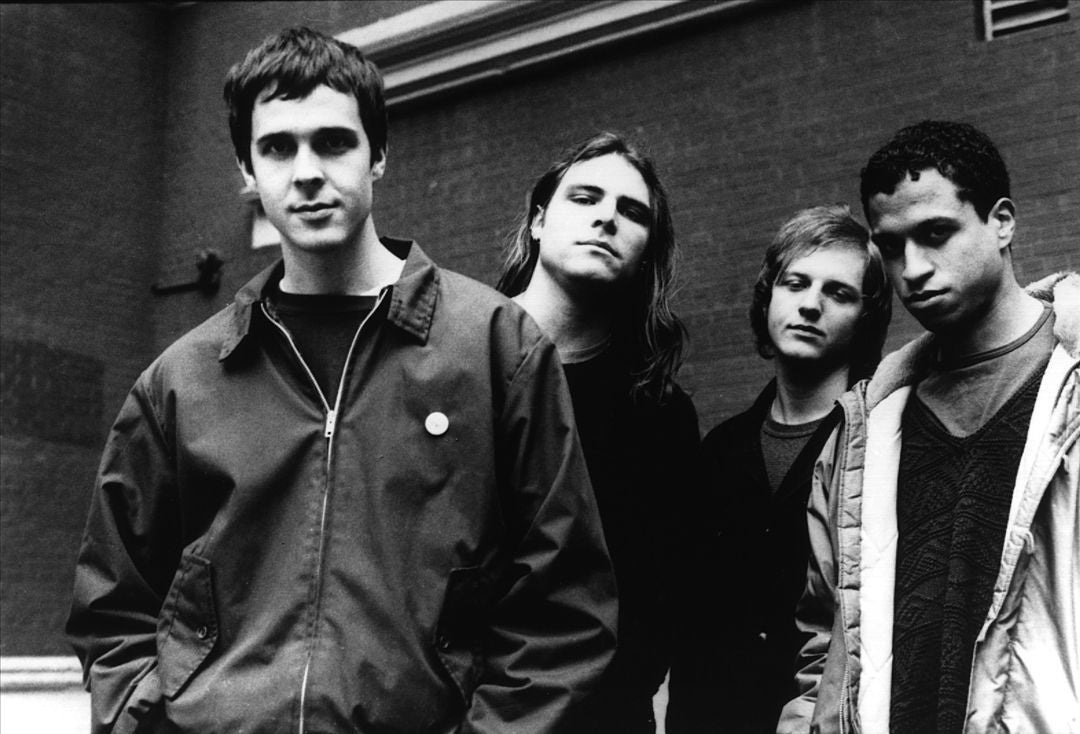
We’ve teamed up with Glassjaw on an exclusive vinyl box set & book celebrating their 30th anniversary. Much of the book is set in the ’90s New York post-hardcore scene that birthed and influenced the band–featuring interviews with those who were there, including members of Quicksand, Burn, Shelter, and more–so, in conjunction with the book’s release, we’re also taking a look back at 21 albums that defined New York post-hardcore throughout that decade. Pick up the vinyl box/book in the BV shop and read on for the list.
Just as New York Hardcore remains a special, unique movement full of intrinsic value to those who lived it as well as those who experienced it secondhand, so does New York Post-Hardcore. Like a lot of subgenres, the origins and definitions of “post-hardcore” are a little nebulous, but the roots go back almost as far as hardcore itself, and there are some widely-agreed-upon turning points. Things start to coalesce in 1984 with a trio of SST releases–Black Flag’s My War, Hüsker Dü’s Zen Arcade, and Minutemen’s Double Nickels on the Dime–and it spirals in multiple different directions from there. Black Flag go further into “post-” territory until their 1986 demise, and Henry Rollins continues down that path with Rollins Band. Touch and Go Records becomes home to pioneering post-hardcore releases by Big Black, Die Kreuzen, and The Jesus Lizard. More “melodic hardcore” than “post-hardcore,” but the later ’80s records by bands like 7Seconds and Descendents opened a lot of people’s minds to the limitations–or lack thereof–within hardcore.
On the East Coast, post-hardcore becomes more of a unified movement in DC before it does in New York, with Revolution Summer making way for Shudder To Think, Jawbox, and the most influential post-hardcore band of all time, Fugazi. And by ’89 into 1990, New York starts to stake its claim. By the dawn of the ’90s, most of the architects of the straightedge/youth crew scene that dominated the late ’80s started to find that the music had become too cookie-cutter, the scene had become too militant, and the shows had become too violent. With a hunger for musical evolution, these musicians formed new bands that took things in a variety of new directions. They saw how Fugazi made it possible to evovle within hardcore, they looked to other New York bands like Sonic Youth (who themselves were infatuated with hardcore), they embraced alternative rock bands like Jane’s Addiction, and they were paying attention when Nirvana changed the course of underground rock music forever. They were really just allowing themselves to take inspiration from anywhere, whether it was My Bloody Valentine or The Smiths or Voivod, and they were channelling everything through a lens that was unique to the New York Hardcore scene. The NYHC roots set these bands apart from everyone else in the world, but the best ones also sounded so different from each other. When New York post-hardcore bands came into existence in the early ’90s, they had a shared ethos, but a myriad of different sounds.
In celebration of this unique and still-influential movement in music, we’ve put together a list of 21 albums that defined ’90s New York post-hardcore. Because, again, the definition can be a little nebulous, here are some caveats: Long Island and New Jersey bands were included if they had a presence in the NYC scene; I left off stuff that felt primarily “melodic hardcore” like Silent Majority, H2O, and Lifetime; I left off stuff that felt primarily metalcore like Deadguy, Vision of Disorder, and Merauder; and I left off stuff that felt primarily noise rock like Cop Shoot Cop and Surgery; though those bands and subgenres are all closely related to what did end up on this list. I capped the list at 21 because 20 just wasn’t enough, but like any album list, this is still just a small snapshot and a starting point. The list is the product of a lifelong love of this music, years of listening and learning, and multiple interviews with the people that created this movement, but there are still bound to be some gems that are only missing because I haven’t heard them yet.
And with that, on with the list, which is presented in as close to chronological order as possible (some exact release dates are hard to come by)…

Bad Brains – Quickness (1989)
Even if it was technically released during the last three and a half months of the 1980s, the impact of Quickness really revealed itself in the ’90s (and has continued to do so since then) and it would be close to impossible to talk about ’90s New York post-hardcore without it. Bad Brains had been influencing the direction of hardcore since their first 7″ and the early days of their now-legendary live show, and they continued to progress their sound and influence new generations all throughout the ’80s. Quickness may not be the widely-appreciated classic that the self-titled LP and Rock For Light are, but for a lot of kids in the late ’80s and early ’90s, it was the first Bad Brains record they heard, and a whole bunch of those kids formed bands. It was heavier, more metallic, more mid-tempo, had more groove, and these were all elements that you would hear replicated throughout the inception of New York post-hardcore in the ’90s. It was also, to quote Bad Brains bassist Darryl Jenifer, “a New York record.” The DC-born band had been living in New York for nearly a decade at that point, and you could hear the uniquely New York brand of cold, hard grit coming through in these songs. A little of the city’s hip hop influence comes through, and it was made with former Cro-Mags drummer Mackie Jayson, who brought some NYHC blood to the band, and who helped Darryl and Dr. Know’s sharp, tight riffs fall perfectly in the pocket.

Supertouch – The Earth is Flat (1990)
Supertouch were never really going to be a “regular” hardcore band. They evolved out of the ashes of the short-lived Death Before Dishonor (not that one), which also birthed Judge, and they made their debut on the second Revelation Records release, the 1987 comp New York City Hardcore: Together. Their song “Searchin’ for the Light” (which would appear again on Rev’s 1988 comp New York City Hardcore: The Way It Is) has some traditional hardcore signifiers, but even on that song, you could tell that something was different about Supertouch. Mark said in a 1989 Jersey Beat interview with Dave Run It that they set out to sound like a cross between Dischord bands Scream and Marginal Man, who had both pushed hardcore in slower, cleaner, more melodic directions–and they were of course also influenced by Bad Brains, who they got their name from–and by the time they released their sole full-length album, they shaped those influences into a sound of their own. The Earth Is Flat stood in stark contrast to most of Supertouch’s Rev labelmates at the time, with a ton of bright melodies in both the guitars and the prominent clean vocals, relaxed tempos, acoustic guitars, some metal, some classic rock, some funk, and a really clear, spacious production style. If they came around a little bit later, or recorded a second album, they might’ve been swept up by the ’90s alternative rock explosion–they were certainly catchy enough to be–but even on their lightest songs, they still had that beating NYHC heart.

Burn – Burn EP (1990)
Even if Quickness and Supertouch (and the first Quicksand 7″) preceded it, the Burn 7″ kind of feels like the big bang for New York post-hardcore. In just four songs, it lays out the blueprint that so many NY post-hardcore bands would follow, and it sounds as modern as the bands who would take post-hardcore to the masses 5-10 years down the line. Expanding upon what he had done in his previous band Absolution, guitarist Gavin Van Vlack completely broke free of the cookie cutter mold of guitar playing that defined New York hardcore in the late ’80s, embracing groovy chugs and dissonance and patterns that went far beyond the use of power chords. Drummer Alan Cage (also of Quicksand) and bassist Alex Napack held down a rhythm section that allowed for slower tempos, dynamic shifts, and more breathing room for Burn to expand their musical palette beyond hardcore. And front and center was vocalist Chaka Malik, whose impassioned shouts and lyrics were full of a variety of different tones and emotions. This wasn’t a hardcore band pointing fingers at back-stabbers; this was a band asking philosophical questions and opening up about inner demons. They defiantly bucked against the conventions of hardcore, and challenged and inspired so many other bands to do the same.

Into Another – Into Another (1991)
Like a lot of the bands on this list, Into Another were formed by members of multiple key ’80s New York hardcore bands who were looking to spread their musical wings. Vocalist Richie Birkenhead previously fronted Underdog and played guitar in Break Down the Walls-era Youth of Today and drummer Drew Thomas was formerly of Bold. They were joined by bassist Tony Bono of the NJ thrash metal band Whiplash and guitarist Peter Moses. Late-period Underdog had already started to bring in more melody and more metal (and more reggae, presumably via Bad Brains), but it wasn’t until Into Another that Richie really proved that he’s a singer. You can hear Richie’s love of Black Sabbath and Judas Priest in his wailed melodies as much as his love of Bad Brains, and the rest of the band follows suit with a ton of variety in their rhythms, tempos, and riffs. There’s metal, there’s punk, there’s avant-garde, and the songs are always just a little too weird to fit neatly into any boxes. Even the catchiest songs will work in a discordant riff or an atypical rhythmic thud, and then there’s the really out-there stuff, like the clattering, percussive “Apalindrome” and the trippy acoustic song “For Lack of a Better World.” There are times when Into Another arrive at a similar place as the PacNW alternative rock bands of the era, but it just hits different when it’s got those NYHC roots in its DNA.

Born Against – Nine Patriotic Hymns for Children (1991)
As hardcore began to splinter off in different directions in the late ’80s / early ’90s, new micro-scenes emerged, including one with a home base at the Lower East Side squad / arts space ABC No Rio. More defiantly DIY and often more overtly political than the bands who were signing to major labels at the time, the ABC No Rio scene offered an alternative to the rules and the structure (and, often, the violence) of the CBGB matinees, and even many of the bands who weren’t directly involved with ABC No Rio eventually started paying attention. One of the scene’s most beloved and influential bands was Born Against. They were formed by two members of the more traditional NYHC band Life’s Blood, and a charismatic hardcore scenester from Albany named Sam McPheeters. After cycling through various drummers and replacing original bassist Neil Burke with Javier Villegas of fellow ABC No Rio regulars Go!, Born Against recorded and released one of the era’s most chaotic records, Nine Patriotic Hymns For Children. In contrast to the metallic, groove-oriented New York post-hardcore bands, Born Against sounded like a more unhinged version of My War-era Black Flag. The lyrics were deeply progressive and political, the music was ferociously and endearingly messy, and Sam was like a bottle rocket on the verge of combustion. They indulged in brainy experimentation without abandoning the unprofessional looseness that made hardcore so inviting in the first place–no easy feat.

Barkmarket – Vegas Throat (1991)
The New York hardcore scene could be pretty insular in the 1980s, but by the early ’90s, there was more of an openness to other local (and non-local) underground music scenes, particularly the noise rock scene that bands like Sonic Youth and Swans had helped shape. And then there were the bands that straddled both of those worlds, like Barkmarket. On their 1991 breakthrough album Vegas Throat, they harnessed the caustic grit of the hardcore scene, the experimentation of the noise and art rock scene (including guest guitar by Marc Ribot), a style of bluesy punk that some people might’ve called “grunge,” and echoes of other styles of aggressive music. It didn’t really fit in anywhere, but the band’s easy-to-like songs also could have fit in everywhere. They sound big and loud, adventurous but focused, and singer/guitarist Dave Sardy knew how to bring his voice to a scream without losing sight of melody. One of the people who saw their mass appeal was Rick Rubin, who signed them to his American Recordings label, though they never really got their due. In a mainstream sense, perhaps this album’s claim to fame is that it was one of the first records produced by Sardy, who would go on to produce and/or mix huge records for System Of A Down, Jet, Oasis, Wolfmother, and more, but Vegas Throat remains one of NYC’s relatively hidden gems that’s still ripe for rediscovery.

Unsane – Unsane (1991)
Also toeing the line between post-hardcore and noise rock were Barkmarket’s better-known and more prolific peers Unsane, whose 1991 self-titled debut LP remains one of the most pivotal records in all of NYC underground music. Production from no wave veteran Wharton Tiers helped cement the band’s connection to the noise/art scene, but it was clear from Chris Spencer’s harsh screams that Unsane were paying close attention to hardcore too. They helped forge a path for bands who were a little too forceful and concise for the former world and a little too exploratory for the latter, and they pretty much perfected their vision off the bat with this LP. It’s the only record with original drummer Charlie Ondras (also of Boss Hog), who died of a heroin overdose the year after this album came out, and it’s also their noisiest record. The slightly clearer production they’d embrace after this would allow them to sound even heavier, but there’s something uniquely charming about hearing how powerful they sound beneath the album’s static-y haze. There’s also something about hearing a new band with new ideas coming out of the gate sounding so entirely sure of themselves.

Helmet – Meantime (1992)
Helmet were not necessarily of the New York hardcore scene–band leader Page Hamilton moved to NYC from Oregon to study jazz guitar, and he first played in the city’s noise rock scene as a member of Band of Susans and Glenn Branca’s guitar orchestra–but they were definitely paying attention to it, and the NYHC scene was paying attention to them too. “Helmet really captured a lot of the spirit of hardcore, but they were doing things that were so out of it,” said Walter Schreifels, while Norman Brannon called them “the band that I would say was probably the most sonically influential to how post-hardcore developed… tuning down your guitars was something that I don’t really remember a lot of hardcore bands doing before Helmet.” After releasing their 1990 debut album Strap It On on the influential noise rock label Amphetamine Reptile, they were scooped up by Interscope for their 1992 major label debut Meantime, and you can still hear echoes of Meantime in post-hardcore today. Drummer John Stanier (now of Battles and Tomahawk) was the most directly connected to hardcore of all the Helmet members–until Rob Echeverria of Straight Ahead and Rest In Pieces later joined on guitar–but he was also into prog and jazz fusion, and he and Page would lock in on these powerful syncopated rhythms that helped introduce a new level of technicality to the burgeoning post-hardcore movement, along with the perfect mix of heaviness and melody. They were already hitting hard on Strap It On, but on Meantime they were writing anthems–it’s no surprise this album carried them into the mainstream the way it did.

Quicksand – Slip (1993)
Quicksand aren’t just the quintessential New York post-hardcore band; outside of Fugazi, they’re the quintessential post-hardcore band, period. They are “post-hardcore” in every sense of the word–band leader Walter Schreifels had previously been the core songwriter in Gorilla Biscuits and a key member of Youth of Today, while other members had done (or were currently doing) time in Beyond, Bold, Absolution, Burn, Shelter, and more, and the difference in tone between the final Gorilla Biscuits album and the first Quicksand 7″ released just one year later could not have been more stark (even with Walter’s short-lived band Moondog bridging the gap). Quicksand kept the sheer force of hardcore intact, but they slowed things down to more of a mid-tempo, allowing for the music to go off in all kinds of different directions. There was more groove, a wider variety of rhythms, a vast array of guitar patterns, and Walter was really singing and packing Quicksand’s music with big hooks. Their 1990 7″ on Revelation immortalized the band’s mission statement, but their 1993 debut album Slip–released on the major label Polydor–perfected exactly what this band was going for. Slip brazenly fucked with the hardcore formula like Fugazi, it was clever like Sonic Youth, it was ethereal like My Bloody Valentine, it slammed like Helmet, it was introspective like The Smiths, it had hooks like Jane’s Addiction; it’s no wonder that Slip has left an impact on so many different types of fanbases over the years. It’s directly informed bands from so many different eras and regions and genres–from Deftones to Refused to Thursday to Title Fight–and the moment that first hit of “Fazer” kicks in, it still feels like it came out yesterday.

Shelter – Attaining the Supreme (1993)
The core duo of Attaining the Supreme-era Shelter–vocalist Ray Cappo and guitarist Porcell–had previously been the core duo of Youth of Today, who helped turn Minor Threat’s straightedge values into a unified subculture, and spawned a ton of imitators in the process. But as the straightedge scene became more and more militant, Ray and Porcell became less and less interested in being part of it. They saw the principles of straightedge–like abstaining from drugs and alcohol and meat–not as the means to an end, but as the beginning of a journey towards self-evolution, which brought both of them to exploring Krishna consciousness. By the early ’90s, Ray and Porcell (or, Raghunath and Paramananda Das) were monks living in an ashram in Philadephia, and they were also spreading the messages of Krishna around the world with their band Shelter. It was in the lyrics, it was in the album artwork, it was spoken about on stage, and the music was just as open-minded as the lyrics. Ray was singing, there were harmonies, there was a variety of rhythms and tempos and styles of guitar playing; and Shelter didn’t sound like the other New York post-hardcore bands either. By the time of Attaining the Supreme (their first album with Porcell as an official member), they’d perfected a bright, catchy style of hardcore-informed music that shared some traits with the later Hüsker Dü and 7Seconds records in a uniquely New York way, while pulling in an array of different influences that ranged from The Smiths to reggae. The messages in the songs might not have been as easy for all their listeners to grasp as the blunt slogans in Youth of Today songs, but the music was even more inviting. Those undeniable choruses helped open Shelter up to an even wider audience than Youth of Today, and not only did they benefit from the open-minded spirit of the early/mid ’90s; they themselves helped foster and grow it.

Rorschach – Protestant (1993)
Rorschach technically hailed from Jersey City, but ABC No Rio was their home base, and their brief but maniacal run left an impact that’s still felt in and beyond NYC today. They started out as a (relatively) more straightforward metallic hardcore band, but by their second and final album Protestant, they’d pushed their music in a variety of different directions. It could be as slow as sludge metal at one moment and as fast as their powerviolence-y ABC No Rio peers Citizens Arrest at another. They pulled from Die Kreuzen as much as they pulled from Voivod. Their combination of atonal noise rock and proto-mathcore bridged the gap between Swans and Converge. From the discordant guitars to Charles Maggio’s harsh shrieks, it offered a much more abrasive alternative to the post-hardcore bands that were getting scooped up by major labels, but not in a way that was reactionary. “We made a conscious decision to play music WE wanted to hear,” said Charles in a 2009 interview with BV. “It was not a rebellion against anything.” Rorschach broke up the same year Protestant came out, with members going on to play in the influential metalcore bands Deadguy and Kiss It Goodbye, and the album’s impact has only grown and inspired more bands over time. Even 30 years later, even in a world full of metalcore and mathcore bands that came in Rorschach’s wake, Protestant still sounds antagonizing.

Die 116 – Dyna-Cool (1995)
When Burn broke up, Gavin Van Vlack went on to form Die 116 and Chaka Malik went on to form Orange 9mm, both of whom released EPs in ’94 and debut albums in 1995 (more on the latter in a second). Gavin had already become disenchanted with the hardcore scene by the time he was playing in Burn, and he found himself a lot more interested in the city’s noise/art rock scene. That really came through in Die 116, which on Dyna-Cool had Gavin and Eric Cooper on vocals/guitar, Manny Carrero (also of Stillsuit) on bass, and Andrew Gormley of Rorschach on drums, with noise rock scene staple Martin Bisi producing. From the album artwork alone–which was made from photographing a circular saw blade and an old air conditioner–it was clear that Die 116 were going for something both threatening and vague, and the music followed suit. Dyna-Cool is even darker, heavier, and weirder than Burn, full of discordance and far-out noise passages and menacing sneers. Instead of cashing in on the increasingly popular post-hardcore sound that Gavin himself helped build, he went in an even more abrasive direction, which–at least on a creative level–yielded results that were extremely rewarding.

Orange 9mm – Driver Not Included (1995)
EastWest
While Gavin was getting darker and weirder with Die 116, former Burn vocalist Chaka Malik took his music in an even groovier direction with Orange 9mm. Chaka formed the band with guitarist Chris Traynor (then also of Fountainhead), and the two quickly proved to be a perfect pair. Chris had these fat, metallic riffs that hit you like a jolt of electricity, and Chaka matched him with charismatic shouts that bordered on rapping and were packed with subtle hooks. After an EP on Revelation and a few lineup changes, they got to work on their major label debut, Driver Not Included, for Elektra subsidiary EastWest. It makes sense that the majors came knocking, as Orange 9mm’s mass appeal was obvious. They’ve been called kindred spirits of Rage Against the Machine, another band who came from hardcore and then inched towards rap rock, and they’re considered an influence on so many early nu metal bands. But, like every band on this list, whatever radio-friendliness they had was balanced out by that unmistakable NYHC backbone. Driver Not Included was produced by Dave Jerden, the same music industry veteran who produced Jane’s Addiction’s Nothing Shocking and Alice In Chains’ Dirt, but it was also co-mixed by Don Fury, the prolific NYHC engineer who worked with basically every band in the scene. Having a team like that is directly reflected in what you hear; Driver Not Included sounds like a big, world-conquering, ’90s alternative rock record, and it also has the attack of a band who came up in the New York hardcore scene. It should’ve gotten even bigger than it did, and nearly 30 years later, it still stands out as a record that sounds like almost none of Orange 9mm’s forebears, peers, or followers.

108 – Songs of Separation (1995)
Like Ray Cappo and Porcell, hardcore led Vic DiCara to Hare Krishna, and he actually briefly played in Shelter before starting his own krishnacore band, 108. (Before that, he played alongside a pre-Rage Against the Machine Zack de la Rocha in Inside Out, and before that he played in Beyond.) When it came time to find a vocalist, he linked up with another Krishna devotee, Rob Fish, who also fronted Ressurection, a heavy NJ hardcore band who at the time shared multiple members with Lifetime. They signed to Ray Cappo’s Equal Vision Records–which Ray originally started as a Krishna-focused label, before selling it to Steve Reddy who later expanded the label’s scope–but as Shelter were spreading their messages through increasingly catchy songs, 108 took a much more abrasive approach. Right in the first song of their sophomore album Songs of Separation, 108 lay out all the human excesses and beliefs and behaviors that they oppose, and throughout the record, they continue to shout their convictions over a taxing, abrasive, very heavy, and often very experimental backdrop. There are times when it nears metalcore territory, but Songs of Separation never falls into any of that genre’s tired clchés. Every chug is tasteful, every scream is an expression of raw, human emotion.

Mind Over Matter – Automanipulation (1995)
Mind Over Matter emerged out of the early ’90s Long Island hardcore scene, and they quickly realized they had no interest in staying within its confines. They looked to bands like Burn and Quicksand and saw how those bands were pushing the envelope musically, lyrically, and visually, and they took that and ran with it. Guitarist Arthur Shepherd especially was into prog and metal, and Voivod’s sci-fi prog-psych-thrash became a guiding light for Mind Over Matter too. “I was ripping off Yes riffs and shit like that,” he says, “and incorporating them into these weird hardcore songs.” Meanwhile, vocalist George Reynolds was writing these personal, conversational lyrics with hyperlocal references and really sowing the seeds for a lyrical style that would pervade Long Island hardcore and emo for years. (In fact, one of their verses was quoted in full on the most popular Glassjaw album.) By the time of their second and final album, Automanipulation, they had completely entered a lane of their own. From the album artwork to hypnotic seven-minute songs like “Suffermouth,” they were diving head-first into abstract art, and still keeping a foot planted in hardcore. Having made their 1994 debut LP Security with go-to NYHC producer Don Fury, they made this one with the NYC noise rock scene’s go-to producer, Martin Bisi. They were obviously at much different levels of popularity, but they could sound at times like Long Island’s answer to Tool, and I think any fans of that band who haven’t heard Automanipulation are missing out. Even within the context of how quickly post-hardcore was progressing in the mid ’90s, Automanipulation was an especially adventurous record that really was ahead of its time. When the bands of the 2000s post-hardcore boom started getting a little artsier on their mid 2000s records, a lot of that could be traced back to Automanipulation.

Shift – Spacesuit (1995)
A lot of bands on this list qualify as “underrated,” but if there’s one band who here who really should and could have gotten way bigger than they did, it’s Shift. Along with Stillsuit, they were part of the slightly younger generation of post-hardcore bands that came up in the Bond Street Cafe scene and followed in the footsteps of what the youth crew graduates were doing. On their Equal Vision-released debut album Spacesuit, they kind of sounded like the exact midpoint between Quicksand and Texas Is The Reason. If you ask me, that’s a winning formula, and Shift perfected it in a way that so many current bands seem to be trying to. They had the thick, metallic backbone of the former and the soaring hooks of the latter, and they sounded big. Joshua Loucka could really sing, they had serious hooks, and the record’s production is even impressive by today’s standards. (It was produced by Into Another leader Richie Birkenhead, and engineered and mixed by Ray Martin, who also worked on Into Another’s Ignaurus and Seemless.) It perfectly straddled the line between hardcore scene bonafides and radio-rock aspirations, and it really is easy to picture Spacesuit‘s title track becoming one of those ’90s fluke hits like Hum’s “Stars” or Superdrag’s “Sucked Out.” Shift did end up on a major for their next album, 1997’s Get In, but it never really took off and the band broke up shortly afterwards. Joshua moved to LA and went on to form the equally catchy but even more underrated band The Big Collapse (which had Manny Carrero on bass for the first record and Gavin Van Vlack on guitar for the second), and the one member who finally did make it big was drummer Samantha Maloney, who went on to drum for Hole, Courtney Love, Mötley Crüe, Eagles of Death Metal, and Peaches.

Native Nod – This Can’t Exist / Today Puberty, Tomorrow the World (1992-1996)
Chris and Danny Leo found their way into the ABC No Rio scene through their older brother Ted–who at the time was an early member of Citizens Arrest and then leader of Chisel (maybe you’ve heard of him)–and Chris said in Anthology of Emo that it was the combination of the ABC No Rio scene, the influence of mid ’80s Dischord stuff like Rites of Spring, the pioneering screamo label Gravity Records, the Sonic Youth / no wave kinda stuff, and the early Seattle grunge scene that informed the music of Native Nod. They befriended members of Born Against, who included a Native Nod song on their 1993 comp Fear of Smell, and Rorschach’s Charles Maggio, who put out Native Nod’s three 7″s on his label Gern Blandsten. The music was expansive, full of quiet-to-loud shifts and suspenseful build-ups, and Chris topped it off with a mix of talking, shouting, screaming, and sometimes-kinda-singing that gained Native Nod a lot of comparisons to Slint (though Chris says he might not have heard Slint until later on). Their artful, expressive music really stood out from most of what was happening in the various New York scenes at the time, but their influence spread far and wide and it continues to do so. They immortalized their impact in just nine songs, first compiled for 1996’s Today Puberty, Tomorrow the World and then re-released (sans “Mr. President” from Fear of Smell) by Numero Group as This Cant Exist in 2023, and Chris went on to further explore similar musical ground in The Van Pelt and The Lapse.

Texas Is The Reason – Do You Know Who You Are? (1996)
RateYourMusic calls New York band Texas Is The Reason “Midwest Emo” and various sources call them “one of the cornerstones of the ’90s emo movement,” but as guitarist Norman Brannon puts it, nobody was calling Texas Is The Reason emo until after they broke up. With members who had done time in Shelter, 108, Fountainhead, Ressurection, and more, they were firmly of the New York hardcore scene, and their open-minded musical approach earned them the “post-” prefix. When you listen to the thick, distorted guitars and the gut-punch rhythm section on Texas’ J. Robbins-produced, Revelation Records-released Do You Know Who You Are?, it’s obvious that you’re listening to a band who lived and breathed hardcore. The sweet, yearning melodies; personal lyricism; and knack for cleanly arpeggiated guitars ended up scratching a similar itch as a lot of the emo bands who were coming out of the Midwest (like Texas’ split 7″ and tourmates The Promise Ring), but none of those bands had the underlying NYHC chug that Texas Is The Reason had–those palm-muted guitars on “If It’s Here When We Get Back It’s Ours” (from the EP and now a DYKWYA? bonus track) are basically mosh parts. Most of the key NYC-area emo bands came from the suburbs, but Texas Is The Reason had that hardened city feel, and that’s a big reason why there’s still no one else truly like them.

Stillsuit – At the Speed of Light (1997)
As mentioned earlier, Stillsuit came up alongside a slightly younger generation of post-hardcore bands like Shift in the Bond Street Cafe scene. They were looking to what Quicksand and Burn were doing, but they were also looking to the harder NYHC stuff, to what was going on in the ABC No Rio Scene, to bands like Sonic Youth, to the ’90s alt-rock explosion, and beyond. While Shift went increasingly towards alt-rock, Stillsuit went in a less inviting direction. They originally formed as Standoff in the early ’90s, put out their debut EP as Stillsuit, Green Spock Ears, in 1995, and released their first and only full-length album, At the Speed of Light, in 1997. It hits hard, it has groove, and it maintains its gritty NYHC foundation, even as it goes off into more abstract territory. The rhythm section of bassist Manny Carrero and drummer Dimi Douvas is pure force and also full of variety, allowing guitarist Orlando Arce to go off on all kinds of open-ended journeys as vocalist Julian Vasquez just loses himself in the music. There’s anger and aggression in his voice but also desperation, and the feeling like he’s grasping for something that’s just out of reach. At the Speed of Light is an album that’s constantly in motion, an album where it always feels like you’ve been dropped right into the middle of the action, with no destination in sight.

Milhouse – Obscenity In The Milk (1997)
With the maniacal vocalist Artie Phillie alongside musicians who played or would later play in Indecision, Loyal To None, SFA, Kill Your Idols, and more, Milhouse had members from both the Brooklyn and Long Island scenes, and the way Artie tells it, they never really fit in anywhere. It’s easy to see why; if their chaotic, abrasive hardcore had any NYHC precedent, it would’ve been in then-defunct bands like Rorschach and Born Against, but the bands they were playing shows with weren’t making this kind of unhinged assault. But as with a lot of other out-of-step bands, Milhouse’s sole album is something that became even more appreciated later on. From the album artwork to the spoken word soundbites to Artie’s caustic screams to the band’s total musical anarchy, Obscenity in the Milk is one of the most genuinely menacing records to come out of New York post-hardcore in the ’90s. Coming out in ’97, it sort of bridged the gap between the proto-mathcore that came out of the early ’90s and the city’s then-burgeoning screamo scene. It still sounds like an outlier today, and it hasn’t lost an ounce of its fury.

Glassjaw – Kiss Kiss Bang Bang EP (1997)
Glassjaw didn’t release a full-length album or break into the mainstream until 2000’s Everything You Ever Wanted To Know About Silence, but the seeds for greatness (and crossover success) were already sown on 1997’s Kiss Kiss Bang Bang EP, their first widely-distributed release (and released when they were still known as The Glassjaw). Vocalist Daryl Palumbo had been playing in straightedge bands and booking shows on Long Island since he was a tween in the early ’90s, Glassjaw formed in 1993, and the band spent the bulk of the ’90s absorbing all the music around them and gradually honing their sound across a series of demos and self-releases. They looked to everyone from Quicksand and Burn to Stillsuit and Mind Over Matter, and they picked up on just about everything happening in New York post-hardcore–the groove, the power, the experimentation, the emotion, the melody–and made it their own. On this EP, Daryl was on vocals, longtime guitarist Justin Beck was still playing drums, and the band’s ever-changing lineup was rounded out by guitarists Todd Weinstock and Kris Baldwin and bassist Ariel Telford, and this lineup of the band had become extremely tight. The rhythm section was a force, the guitars could go from thick and chunky to sprawling and adventurous, and Daryl had developed a style that would make him one of the most iconic and influential vocalists in 21st century heavy music. He could scream, he could really sing, and he had so much attitude and personality in his delivery. The instrumentation was steeped in New York post-hardcore, but Daryl’s vocals were something new and different. It’s fitting that the list ends here, because Glassjaw were kind of the band who closed the book on ’90s post-hardcore and opened the doors for what post-hardcore would become in the 2000s. The following decade was full of Daryl Palumbo-inspired vocalists–some of whom would become trailblazers in their own right–but none ever did it quite like him, and none had harnessed the attack of New York City post-hardcore quite the same way.
https://youtu.be/nGwOfNtrwn0?si=c7aynOiRHX5BJfqN
—
If you’re into the albums on this list, you may also like our new exclusive Glassjaw 30th anniversary vinyl box set & book, the latter of which is largely set in the New York and Long Island post-hardcore scene of the ’90s and features interviews with some of the bands on this list. Pick that up in the BV shop.

Listen to a Spotify playlist containing every album from the list (except the Glassjaw EP which isn’t on streaming services):
SEE ALSO: