
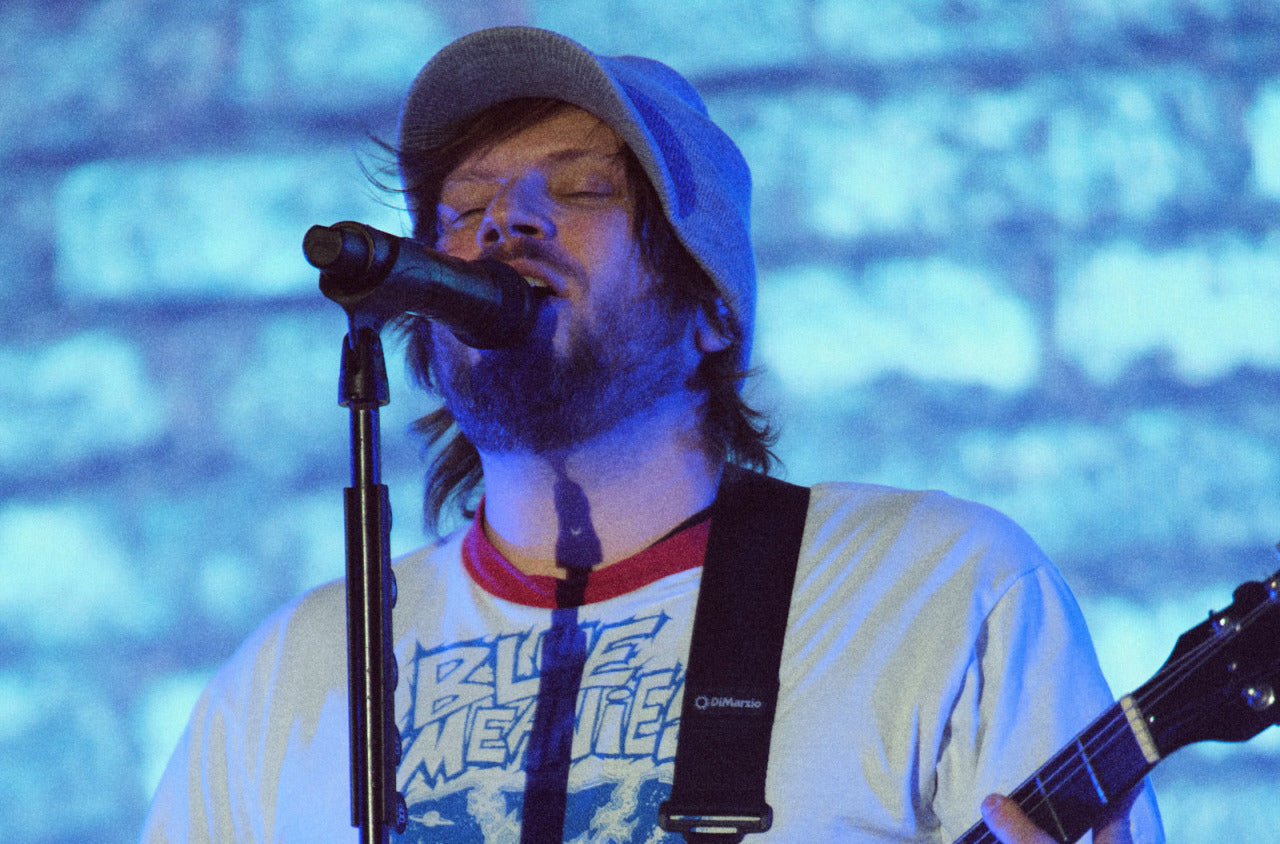
As Fall Out Boy singer Patrick Stump rose to the forefront of punk and emo, he remained a lifelong ska fan, and more recently he’s been publicly opening up about his love of the genre–he just wore a Blue Meanies shirt on stage at the When We Were Young festival this past weekend, as pictured above. He appeared on Aaron Carnes and Adam Davis’ ‘In Defense of Ska’ podcast back in 2021 and returns for a new episode that’s out today, and he was also interviewed for a new section of the second edition of Aaron Carnes’ ‘In Defense of Ska’ book, which comes out October 29 via Clash Books and is up for pre-order now. That section of the book gets its exclusive debut right here:
**
In 2000 Billy Spunke, lead singer for Blue Meanies got word that WGBK, a radio station in Glenview, Illinois, wanted to interview him. Glenview is a suburb thirty minutes north of Chicago. And the station, it turned out, was in Glenbrook High School. The school had purchased the station from the Midwest Academy, a private Christian school affiliated with the General Church of the New Jerusalem. They broadcasted to people in the general area. WGBK was—is—a legit noncommercial radio station that is “programmed like an alternative rock station with a college rock feel,” as one blogger wrote. The only weird part for Spunke was that he had to walk through the halls of a functioning high school before sitting in front of a microphone and talking about the group’s upcoming major label debut album, Post-Wave.
But another weird thing happened. When Spunke got to the station, a short and nervous sophomore was sitting, eyes aimed at the microphone; an audience of one, not saying anything. When the interview started, the kid listened intently to every word Spunke said. Afterward, he didn’t introduce himself to Spunke. Maybe he was too nervous. It wasn’t entirely clear. But that kid turned out to be Patrick Stump, who in a few years would graduate from high school and join Fall Out Boy, getting the gig as their guitarist/singer once the other members heard his passionate, confident voice, a bizarre contrast to his nervous demeanor.
Stump had a program at the station—not the show Spunke was on. He played a lot of straight-edge hardcore and Midwest emo but also wedged in some Hot Stove Jimmy and Blue Meanies. Stump showed up at the station early and begged the DJ to let him watch the Spunke interview. He loved Blue Meanies and had a deep passion for ska. “I had no business being there,” Stump tells me. “I was obsessed. I was like, tell me everything.”
During Fall Out Boy’s run, the only significant sign of Stump’s love for ska snuck in through the vocals. His two biggest singing influences were Chris Conley from Saves The Day and Jaime Woolford from the Minneapolis ska-punk band Animal Chin.
Otherwise, Stump’s ska roots flew under the radar. As the ’00s progressed and Fall Out Boy grew more popular, ska became distasteful. He didn’t say much about it at all. “I kept it to myself because it was very uncool to talk about all of a sudden,” Stump says. His early attempts to bring ska riffs to the band weren’t permitted. He tried to add upbeats to the bridge of “Calm Before The Storm” but the other members said no. Years later, in 2021, Stump chose to reveal his ska roots on my podcast, In Defense of Ska, cohosted by Link 80 guitarist Adam Davis.
A whole bunch of people lately seem suddenly comfortable talking about their ska pasts, a major cultural shift from the prior two decades, and a sign that maybe ska isn’t as uncool as it was when I started this book in 2013. Margaret Cho, Ted Leo, Brian Fallon, and Laura Jane Grace have all confessed their love for ska on my podcast. Jake Matter, the bassist from ska-core band Grey Matter, also started the Twitter account Ska or Nah in 2019 to pester famous people about their tastes in ska, and surprisingly, many responded. He first jokingly asked Jer of Skatune Network if they liked ska. They said, “Nah.”
His first real tweet was at sludge metal band Thou, who responded with “Yes” and followed that with “No.” Bigger celebrities have responded, like Elvis Costello (he posted a video of the Skatalites’ “Phoenix City” and said, “Nothing More Need Be Said.”) Actor Matthew Lillard responded with, “Madness is my most favoritist (sic) band. Ever.” Skateboarder Tony Hawk’s response was, “Does having Specials, Madness, Selecter, and Operation Ivy on vinyl in the 80’s answer your question?”
“I just ask famous people if they like ska. And because ska is so divisive—still a majority of people don’t respond—but if you catch someone that likes it, they’ll say, hell yeah! Or, if somebody doesn’t like it, they’ll definitely let you know. And it’s gotten massively popular. When someone says no, it’s almost always very funny. Converge said, ‘Fuck No.’ It was nice,” says Matter.
I only knew about Stump’s history because Brian Diaz, singer for Long Island ska band Edna’s Goldfish, joined us on the podcast—an early episode, but one that revealed a lot of ska history. Since ska has been marginalized for so long, Davis and I quickly realized that there were endless untold ska stories. During Diaz’s interview, he revealed that major labels courted Edna’s Goldfish and that Mr. Ska himself, Moon Records’ Rob Hingley told the band to lean into their non-ska side for their single “Veronica Sawyer.” After Diaz’s time in ska ended, he found himself doing guitar and bass tech work with Fall Out Boy. One night he played the opening lick for Animal Chin’s “Bleed” during soundcheck and caught an enthusiastic response from Stump, who immediately joined him on the drums to jam out the song. Diaz did not anticipate that reaction, but enjoyed it nonetheless. Over the years, they’ve done this from time to time, a little inside connection—no one else in the band or the crew has any clue what song they’re playing. Diaz has even created a personal challenge to play Animal Chin in as many countries as possible. When Fall Out Boy planned to play Antarctica to beat a world record of playing in every continent in a set amount of time, Diaz thought about playing “Bleed” to penguins. He even texted Woolford to give him a heads-up. Antarctica ended up not happening due to weather conditions. Metallica swooped in and broke the record before they got a chance.
After our interview, I asked Diaz if he thought Stump would want to come on the show. Stump emailed me a day later and said that he would “kill to talk about ska.”
He told us his complete story. He first heard about ska from one of his older brothers’ girlfriends, who brought over some ska tapes: Dance Hall Crashers’ Old Record and Mustard Plug’s Big Daddy Multitude. “Big Daddy Multitude looked crazy. A guy covered with mustard. I was really obsessed with that one and wanted to get it. Dance Hall Crashers, I loved the name,” Stump says. His brother’s girlfriend explained to Stump what ska was: like punk, but weird. He was on board! Specifically, he liked the musical complexity of ska, its use of melodies, harmonies, and countermelodies. It was like orchestration in a punk context, without the overtly aggressive punk elements.
He made an extensive Christmas list by going through the liner notes of a couple of ska tapes he could get his hand on. His parents got him all the mainstream stuff easily accessible at the local Best Buy, like Reel Big Fish’s Turn The Radio Off and Goldfinger’s self-titled album. But they also found some weirder ones, like Mephiskapheles’ God Bless Satan and Suicide Machines’ Destruction By Definition. “God Bless Satan—I loved that record. It was off to the races after that.”
Fortunately for Stump, his high school radio station also played Chuck Wren’s radio show, Everything Offbeat. In 1992, Wren started Jump Up Records, but throughout the ’80s and ’90s, he played a pivotal role as a Chicago DJ. Wren was the man. He introduced a lot of kids in the greater Chicago area to a wide range of ska, including traditional Jamaican, 2 Tone, obscure American bands, and ska from all over the globe. Suddenly, this seemingly small scene was a massive genre. Stump recorded songs he liked on his cassette player. “I listened to that religiously. I got acquainted with a lot of older ska because he would sprinkle in Bad Manners or Fishbone. Fishbone were probably my favorite band, and I didn’t even know that they were a ska band. I watched them on Saturday Night Live. I thought they were a cool, weird metal band. Then Chuck Wren would play all that [early ska] stuff, and I’m like, where’s this thing been my whole young life?”
Not only was Stump obsessed with tracking down every ska album he could find, he wanted to know the details of each member in the same way some kids obsess over baseball stats. “I knew the names of everybody that played saxophone in Skavoovie and the Epitones. I remember Reel Big Fish had horn players who’d clearly written on their early stuff that weren’t in the band by the time the record came out. I remember being a little kid, like, who are these guys? Where are they?” Stump says.
His first ska show was Reel Big Fish at the House of Blues in Chicago, with openers Kara’s Flowers, a non-ska band that would soon become Maroon 5 (they got booed off stage that night). Stump was a nervous, borderline agoraphobic kid, so heading out to the show in Chicago was tough despite how eager he was to finally see a real live ska show. He talked his sister into taking him, and he wore his 2 Tone, wing-tip Doc Martens. Once there, he found himself a spot in the back, away from everyone, and skanked by himself. “It was the kind of thing where if anyone made even eye contact with me, I would have hidden forever. But in the moment, I was very there,” Stump says.
His goal was to play drums in a ska band. As a young child, he started playing makeshift drums (i.e., buckets), then graduated to a shitty $175 drum kit after relentlessly bugging his parents. They didn’t have a lot of money, so that was tough for them. He made good use of those drums. Stump would drum along to different ska songs, like the opening section of Goldfinger’s “Here in Your Bedroom” or to Rancid records. Later he would study traditional ska bands. Hepcat was a favorite.
Try as he might, he couldn’t find people to join him in his quest to start a ska band. Everyone already interested in the genre was in local band New Jacks, who Stump tried desperately to join. The opportunity never arrived. The closest Stump got to be in a ska band was a talent show performance where he and a group of kids he threw together played Mustard Plug’s serial killer anthem, “Mr. Smiley.” Unable to find a bassist/singer, he switched to both, finding someone else to play drums. “I basically asked all the horn players from marching band. And the jazz teacher had a bass that he was willing to let me borrow for some crazy reason,” Stump says. “It was my most successful ska band. I couldn’t get anybody else on board. I just wanted to play ska.”
Minneapolis trio Animal Chin was very important to him, not just because of Woolford’s vocals but also his unique songwriting style, and how he approached songwriting as a three-piece hornless band. Animal Chin released two LPs: All The Kids Agree (1997) and 20 Minutes From Right Now (1999). It was an eclectic band that subverted many of the traditions of ’90s ska punk, playing with Propagandhi-like ferocity, singing about animal rights, and criticizing the closed-mindedness of the scene. Woolford had a unique voice that was punk rock and soulful. His melodies traversed the scale, demonstrating range and precision. His biggest vocal influences include Ted Leo and The Cardigans.
“All the Kids Agree—that’s one of my favorite records, like a desert island disk to me. I spent a lot of time learning about singing from that record,” Stump says. “I was somebody that came to ska because of the musicality; I really love countermelodies and polyrhythms and harmonies. Here was this record with three people; it was like a symphony, just incredible. That was exciting for me to be like, you can be this dumb, shitty punk band—they weren’t a shitty punk band—how you can order instruments in a way to make very little sound like a lot.”
In 2021, when the Covid-19 lockdown started to loosen, Fall Out Boy headed out on their summer arena tour with Green Day, Weezer, and openers the Interrupters, and Stump returned to the world of live music showing off his ska side a little more than he did before the pandemic. Diaz tells me that he heard him sound-checking his guitar with the Bosstones’ “The Impression That I Get” and occasionally wore a Specials shirt on stage. One time Diaz wore his old NYC Moon Ska shirt, and Stump told him that he needed one too, but there weren’t any available to buy. “I’m like, it was a limited run, and Buck’s done with them,” Diaz says, then thinks about it. “Can I convince Buck to make one more for the guy from Fall Out Boy so he could wear it on stage?”
**
Aaron Carnes has various live events with various guests happening between this week and late December in support of the second edition of ‘In Defense of Ska.’ Find those dates listed below, alongside his new podcast episode with Patrick Stump. Pre-order the second edition of the ‘In Defense of Ska’ book from Clash Books.

Aaron Carnes (In Defense of Ska) — 2024 Book Tour Dates
Oct 24: Time Tested Books in Sacramento w/ Keith Lowell Jensen at 7p
Nov 3: Fall Brewing in San Diego W/ Julia Dixon Evans
Nov 4: Vromans Books in Pasadena w/ Dan Ozzi
Nov 15: Third Place Books in Seattle
Nov 17: Portland TBD
Nov 21: Green Apple Books in San Francisco w/ Laura Albert
Dec 5: Barnes & Noble in Philadelphia w/ Sadie Dupuis
Dec 6: Broken Goblet in Bensalem, PA with Marc Wasserman (Also bands, Hub City Stompers are headlining I think)
Dec 7: Scottish Dave’s Pub in Clinton, CT w/ PWRUP
Deb 8: New York City TBD
Dec 14: Hey Cafe in New Orleans. New Orleans panel with a bunch of people
Dec 19: Art Boutiki in San Jose w/ Mat Weir. Part of Drink & Draw. Music by Reggaedelic
